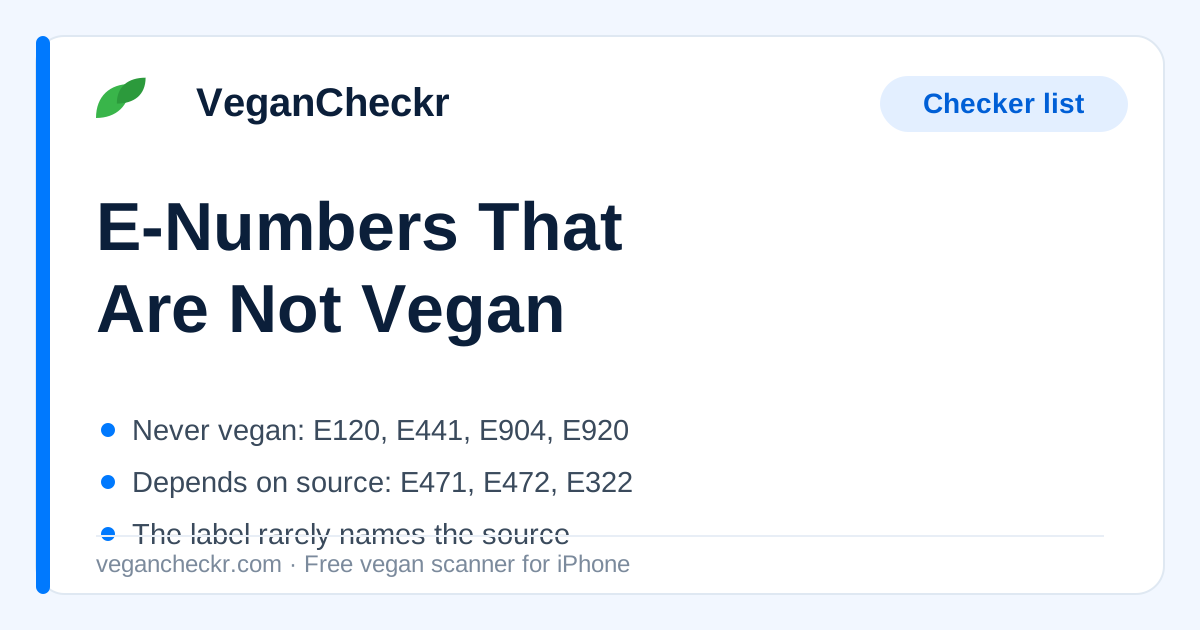
✗ Not vegan E120, E441, E542, E901, E904, E913 and E966 are always animal-derived. A second group, including E920, E471, E472a–f, E322, E570, E631 and E627, can be vegan or not, and the label rarely reveals the source. E422 (glycerol) used to belong in that group and no longer does inside the EU.
That second group is the real problem. Most non-vegan E-number lists stop at the obvious insect dyes and bone derivatives, but the additives you'll actually meet every day are the ambiguous ones: emulsifiers and flavour enhancers that are usually plant-based, sometimes not, and never labelled with their origin. This guide splits all of them into three clear tables so you can check any ingredient list in seconds.
Which E-numbers are not vegan?
Seven E-numbers are always animal-derived: E120 (carmine, made from crushed cochineal insects), E441 (gelatin, from animal skin and bones), E542 (bone phosphate), E901 (beeswax), E904 (shellac, a resin from the lac insect), E913 (lanolin, from sheep's wool) and E966 (lactitol, made from milk whey). A second group can be vegan or not depending on the source, because labels are not required to reveal an additive's origin: E920 (L-cysteine), E471 and E472a–f (fat-based emulsifiers), E322 (lecithin), E570 (fatty acids), and the flavour enhancers E631 and E627. To settle those, look for a vegan certification mark or a declared plant source such as “soy lecithin”, or ask the manufacturer directly.
Why the label won't tell you the source
In the EU and UK, food additives are governed by Regulation (EC) No 1333/2008, which maintains the Union list of approved additives and how they may be used. Labels must state an additive's function (emulsifier, colour, preservative) plus its name or E-number, and that's it. The origin sits in a separate technical document, Commission Regulation (EU) No 231/2012, which sets purity specifications but doesn't force manufacturers to reveal whether a specific batch came from plants or animals.
So an E-number on a packet tells you the additive is approved as safe. It tells you nothing about whether an animal was involved in making it.
An E-number answers the safety question, not the source question. The label only ever answers the first — the second is up to you.
E-numbers that are never vegan
These additives are made from insects, bones, milk or other animal materials. If you see any of them, the product is not vegan; no further checking needed.
| E-number | Name | What it's made from | Typical products |
|---|---|---|---|
| E120 | Carmine / cochineal | Crushed cochineal insects | Red sweets, drinks, yoghurts |
| E441 | Gelatine | Animal skin, bones and connective tissue | Gummies, marshmallows, capsules |
| E542 | Bone phosphate | Cattle or pig bones | Anti-caking agent in dry foods, supplements |
| E901 | Beeswax | Honeycomb from bees | Glazed sweets, fruit coatings |
| E904 | Shellac | Resin secreted by the lac insect | Shiny coatings on sweets, pills, citrus |
| E913 | Lanolin | Grease from sheep's wool | Chewing gum bases, vitamin D3 production |
| E966 | Lactitol | Lactose from milk whey | Sugar-free sweets and chocolate |
One note on this table: E441 gelatine is nowadays treated as an ingredient rather than an additive in the EU, so you'll usually see the word “gelatine” instead of the number. The number itself still appears on imported products and older labels, though.
E901 and E904 are insect products, so they're generally fine for vegetarians but not for vegans, the same logic that applies to honey.

 Check it in seconds with VeganCheckr
Instead of memorizing eight numbers, let the scanner flag them for you:
- Open VeganCheckr and tap Scan, then point your camera at the barcode.
- No barcode? Use the ingredient scan to photograph the printed ingredient list.
- Read the verdict. Flagged additives like E120 are listed by name with the reason ("carmine: made from cochineal insects").
E-numbers that depend on the source
This is the group that trips people up. Each of these additives can be made entirely from plants (and usually is), but animal-derived versions are permitted and indistinguishable on the label.
| E-number | Name | The risk | In practice |
|---|---|---|---|
| E920 | L-cysteine | Animal keratin or microbial fermentation | Source-dependent; the label rarely identifies the route |
| E471 | Mono- and diglycerides of fatty acids | Made from plant oils or animal fat | Mostly palm, soy or rapeseed today, but not always |
| E472a–f | Esters of mono- and diglycerides | Same fat base as E471 | Same caveat as E471 |
| E322 | Lecithin | Can be made from egg yolk | Overwhelmingly soy or sunflower; egg lecithin is rare and usually declared |
| E422 | Glycerol | Vegetable oils and fats only in the EU since 20 July 2023; plant or animal elsewhere | Vegan in the EU by law; check outside it |
| E570 | Fatty acids (incl. stearic acid) | Plant or animal fat | Stearic acid is naturally more abundant in animal fat |
| E631 | Disodium inosinate | The code does not disclose its manufacturing source | Use vegan certification or a product-specific source declaration |
| E627 | Disodium guanylate | The code does not disclose its manufacturing source | Often paired with E631; verify the finished product |
| E270 | Lactic acid | The name suggests milk | Almost always vegan: made by fermenting plant sugars, not dairy |
E270 is on this list mainly to reassure you: despite the dairy-sounding name, industrial lactic acid is made by bacterial fermentation of carbohydrates like glucose or starch, so it's vegan in nearly every product you'll meet. MSG (E621) itself is also fermentation-made and vegan; the genuine question marks in savoury seasoning are often E627, E631 and E635. Other source checks include E920 and the fat-derived emulsifiers E471, E472a–f and E570.
Your practical options for this group: look for a vegan certification mark, look for a declared source ("emulsifier (E471) from vegetable origin" or "soy lecithin"), or contact the manufacturer. Many mainstream brands now declare plant sources voluntarily; our guides to E471 and E322 cover exactly what those declarations look like.
Common E-numbers that are vegan-safe
Most additives are synthetic, mineral or plant-based, and no animal-derived version is in commercial use. These are the ones you'll see constantly and never need to worry about.
| E-number | Name | What it is |
|---|---|---|
| E100 | Curcumin | Yellow pigment from turmeric |
| E140 | Chlorophylls | Green pigment from plants |
| E162 | Beetroot red | Colour from beetroot |
| E163 | Anthocyanins | Colours from grapes and berries |
| E202 | Potassium sorbate | Synthetic preservative |
| E211 | Sodium benzoate | Synthetic preservative |
| E300 | Ascorbic acid (vitamin C) | Made from glucose |
| E330 | Citric acid | Fermented from sugars, not citrus or animals |
| E406 | Agar | Gelling agent from seaweed |
| E407 | Carrageenan | Gelling agent from red seaweed |
| E412 / E415 | Guar gum / xanthan gum | Plant and fermentation thickeners |
| E440 | Pectin | Gelling agent from fruit |
A useful pattern: seaweed gums (E406, E407), fruit pectins (E440) and fermentation acids (E330) are the vegan replacements for gelatine in most modern sweets, which is why some gummy ranges are accidentally vegan while others aren't.
How to check a real product, step by step
Standing in an aisle, here's the fastest workflow. First scan the ingredient list for the never-vegan numbers above. Any hit ends the check. Then look for the ambiguous group; if you find E471, E472, E631 or E627, check for a vegan mark or a declared plant source before assuming either way. Finally, remember that E-numbers are only part of the label: hidden animal ingredients like whey powder, honey or fish gelatine appear under plain names, not numbers.
Our guide to reading food labels as a vegan covers the full method, and the ingredient checker guide shows how to analyze a pasted ingredient list when you're researching from home.
Handle the ambiguous additives automatically
VeganCheckr is built for exactly the depends-on-source group:
- Scan the barcode or photograph the ingredient label.
- Ambiguous additives like E471 and E322 are flagged with a "check the source" warning, with fewer false flags when the label already declares a plant source like soy lecithin.
- Type any E-number into ingredient analysis to look it up directly, and set personal avoidance alerts for additives you always want flagged.
Frequently asked questions
Which E-numbers are never vegan?
E120 (carmine), E441 (gelatine), E542 (bone phosphate), E901 (beeswax), E904 (shellac), E913 (lanolin) and E966 (lactitol) are always animal-derived. E920 (L-cysteine) is source-dependent: it can be made from animal keratin or by microbial fermentation, and a normal label rarely identifies the route.
Is E471 always non-vegan?
No. E471 (mono- and diglycerides of fatty acids) is usually made from plant oils such as palm, soy or rapeseed, but it can also be made from animal fat. The label does not say which, so the only ways to be sure are a declared plant source, vegan certification or asking the manufacturer.
Do EU labels say whether an E-number is animal or plant based?
No. Under Regulation (EC) No 1333/2008, additives are labelled with their function plus their name or E-number, not their source. An approved additive can be of animal, plant, mineral or synthetic origin with no difference on the label.
Is E120 vegetarian?
No. E120 (carmine, also listed as cochineal or carminic acid) is a red dye made from crushed cochineal insects, so it is neither vegan nor vegetarian. Watch for it in red sweets, drinks, yoghurts and lipsticks.
Check any product in seconds
VeganCheckr scans barcodes and ingredient labels, flags hidden animal ingredients and E-numbers, and shows you the evidence. Free to download on the App Store and Google Play. Optional Premium features vary by platform.

 Scan with your iPhone camera