? Source-dependent E627, E631 and E635 can be vegan, but the code alone cannot prove it. The number identifies a flavour-enhancing compound, not its manufacturing feedstock. Fermentation-made supplies exist, while official food-additive specifications do not require the package to name the production route. Use vegan certification or ask the manufacturer.
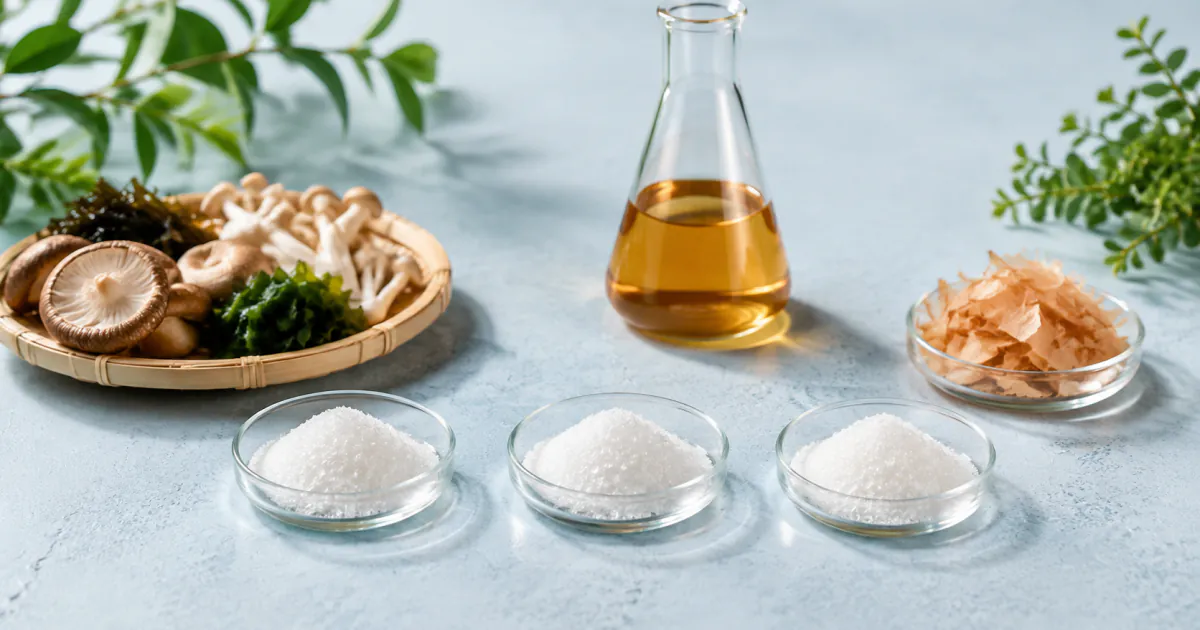
What E627, E631 and E635 actually mean
The codes belong to a family called ribonucleotides. E627 is disodium guanylate, also written sodium 5′-guanylate or GMP. E631 is disodium inosinate, also called sodium 5′-inosinate or IMP. E635 is a controlled mixture of disodium inosinate and disodium guanylate. Manufacturers use them to amplify savoury, or umami, flavour.
The FAO/WHO Joint Expert Committee on Food Additives records each identity separately in its specifications for INS 627 disodium 5′-guanylate, INS 631 disodium 5′-inosinate and INS 635 disodium 5′-ribonucleotides. “INS” is the international Codex numbering system; the corresponding E-number is used on European labels.
The Codex General Standard for Food Additives separately lists INS 627, INS 631 and INS 635 as flavour enhancers and records where they may be used. Those entries describe technological function and provisions, not a vegan-certified feedstock.
| Code | Official name | What the code proves | Vegan decision |
|---|---|---|---|
| E627 / INS 627 | Disodium 5′-guanylate | The finished compound and additive function | Verify source or finished-product certification |
| E631 / INS 631 | Disodium 5′-inosinate | The finished compound and additive function | Verify source or finished-product certification |
| E635 / INS 635 | Disodium 5′-ribonucleotides | A mixture of disodium inosinate and guanylate | Both components need a compatible source |
| E621 / INS 621 | Monosodium glutamate | A different flavour enhancer | Modern commercial MSG is fermentation-made and vegan |
Why the E-number cannot certify the source
An additive specification answers a chemistry and purity question. For example, the JECFA specification defines E635 as a near-even mixture of the inosinate and guanylate salts and sets identity tests and purity limits. The EU’s food-additive specification regulation likewise gives E627 and E631 their chemical names, formulas and purity criteria. Neither entry functions as a vegan sourcing certificate.
That distinction is not theoretical. EFSA has evaluated specific disodium inosinate and disodium guanylate products made by microbial fermentation. Its opinions describe fermentation-made disodium inosinate and fermentation-made disodium guanylate. Those assessments concern named feed-additive products, so they prove that fermentation routes exist, not that every food-grade E627 or E631 uses the same route.
A manufacturing patent published in 2009 records fish-meat extraction, RNA digestion, microbial fermentation and combined fermentation-and-synthesis as known ways to prepare disodium inosinate before detailing its own fermentation process. This primary process document proves that multiple technical routes have existed; it does not show which route a current supplier uses or how common each route is today. The sensible conclusion is narrow: do not label every E631 “pork,” “fish” or “animal,” and do not label every anonymous E631 vegan. Ask about the exact supplier route.
The E-number names the molecule. A vegan mark or supplier declaration names the sourcing decision.
E635 inherits both questions
E635 is not a mysterious fourth substance. JECFA defines it as a mixture of disodium inosine-5′-monophosphate and disodium guanosine-5′-monophosphate, with each contributing roughly half of the blend. This is why labels may say “flavour enhancers (E621, E635)” rather than listing E627 and E631 separately.
For a vegan verdict, E635 is only as clear as its two components. A supplier statement that merely expands E635 to “inosinate and guanylate” repeats the identity and still does not answer the source. Useful evidence says the material was produced by fermentation or from a specified non-animal substrate, or confirms that the exact finished product meets a recognised vegan standard.
Why E621 is a separate answer
MSG often appears beside these codes because glutamate and ribonucleotides reinforce the same savoury sensation. That pairing does not give them a shared origin. E621 is monosodium glutamate, while E627 and E631 are nucleotide salts. Modern commercial MSG is made by fermenting carbohydrate feedstocks, as explained in our E621 and MSG guide.
So do not reject a product merely because it lists E621, and do not clear E631 merely because E621 is present beside it. Read each code on its own evidence. The same rule applies to source-dependent E471: a number can be chemically precise while remaining incomplete about raw materials.
Where these flavour enhancers appear
E627, E631 and E635 are used at low levels in intensely savoury foods. Common places to find them include:
- flavoured crisps, corn snacks and savoury crackers;
- instant noodles, soup bases and seasoning sachets;
- stock cubes, bouillon powders, gravy granules and packet soups;
- spice blends, rubs, sauces and savoury meal kits;
- some meat alternatives and ready meals.
These categories often contain easier deciding ingredients too. Chicken powder, beef extract, fish sauce, whey, cheese powder and animal fat settle the product verdict without any nucleotide investigation. Scan the whole list before spending time on a supplier query.
 Check the full seasoning, not one code
VeganCheckr can scan the barcode or ingredient panel and separate clear ingredients from source-dependent ones:
- Identify E627, E631 or E635 as a sourcing question rather than an automatic rejection.
- Catch decisive ingredients such as milk powder, fish sauce or animal fat elsewhere in the recipe.
- Use the attached evidence to ask the manufacturer one focused question when the product remains uncertain.
How to verify a product efficiently
- Prefer an exact vegan certification. It covers the finished formula, not only one additive, and is the quickest useful evidence.
- Check the manufacturer’s current product page. Match the country, flavour and pack because recipes can vary between markets.
- Ask about manufacture, not just identity. Request whether the E627, E631 or E635 used in that product is made entirely without animal-derived raw materials, growth media and processing aids.
- Keep the response. Record the product name, market and date so an old answer is not applied to a changed formula.
A clear question might read: “Is the E635 in the current 150 g barbecue product sold in Belgium produced by microbial fermentation or another fully non-animal process, including its processing aids?” That is more likely to reach a technical team than “Is this vegan?” and it prevents a generic answer about E-numbers.
Our broader non-vegan and source-dependent E-number list helps triage a long label. For an additive the list cannot settle, the food-verification workflow shows how to rank packaging, certification and manufacturer evidence.
What a useful manufacturer answer looks like
“Our E631 complies with EU regulations” is not a sourcing answer. Compliance confirms that the substance meets the authorised identity, use and purity rules; it does not state which raw materials or production aids supplied it. Likewise, “there are no allergens in the additive” does not establish vegan manufacture, because vegan status is wider than regulated allergen disclosure.
A useful reply identifies the exact product and says that its E627, E631 or E635 is produced by microbial fermentation, or otherwise confirms no animal-derived raw materials or processing aids are used. The strongest reply comes from the technical or quality team and is tied to the current market formula. A general customer-service statement copied across every flavour is weaker.
If the company will not disclose the route, the honest verdict is unknown rather than non-vegan. You can choose a certified alternative without repeating an unsupported claim about pork or fish. That approach is both more accurate for shoppers and fairer to manufacturers whose modern fermentation supply is compatible with vegan standards.
Common claims to avoid
“E631 always comes from pork”
This is inaccurate. Official EFSA assessments document fermentation-produced disodium inosinate, so animal origin is not inherent to the molecule. A pork-specific claim requires evidence about the exact supply chain, not a viral additive list.
“All E635 is plant-based now”
This overcorrects in the other direction. The regulatory code and purity specification still do not disclose the feedstock used for a particular batch. Modern fermentation availability is encouraging, but it cannot replace product-specific evidence.
“E627 is fine but E631 is not”
Both require the same style of sourcing check when no vegan claim is present. They are different compounds, but the package code alone is not a manufacturing declaration for either one. E635 contains both, so an unexplained mixture remains unexplained.
Frequently asked questions
Is E631 vegan?
E631 can be vegan when it is made by microbial fermentation or another verified non-animal route. “E631” or “disodium inosinate” alone does not disclose that route, so rely on a vegan-certified finished product or a current manufacturer statement.
Is E627 vegan?
E627 can also be vegan, and EFSA has assessed a specific fermentation-produced disodium guanylate. That does not prove the source of every food-grade supply. Treat an unspecified E627 as source-dependent rather than automatically animal-derived.
Is E635 vegetarian?
It is vegetarian only when both the inosinate and guanylate in the mixture come from vegetarian-compatible sources. A vegetarian or vegan certification on the exact finished product is the simplest answer; the E635 code by itself is insufficient.
Are E627, E631 and E635 the same as MSG?
No. MSG is E621, monosodium glutamate. E627 is disodium guanylate, E631 is disodium inosinate and E635 combines the latter two. They may be used together, but E621’s fermentation-based vegan verdict does not automatically carry over to the other codes.
Check any product in seconds
VeganCheckr scans barcodes and ingredient labels, flags hidden animal ingredients and E-numbers, and shows you the evidence. Free to download on the App Store and Google Play. Optional Premium features vary by platform.

 Scan with your iPhone camera