✓ Generally vegan Sulphites and animal-derived ingredients are separate questions. The warning deserves attention if it affects your health, but it is not, by itself, a reason to classify a food as non-vegan.
 Check your own packet
Use VeganCheckr to separate a preservative name from the rest of a food's ingredients:
- Scan the barcode or photograph the full ingredient list, including any coating or filling.
- Compare the available product record with the packet in your hand.
- Review the flagged animal ingredients and unresolved sources. For wine, also check the producer's current vegan statement.
Download for iPhone Get it for Android
Free to download, with optional Premium features that differ by platform. Scanning cannot measure sulphite levels, certify allergy safety or reconstruct undisclosed winery processing.
Sulphites, sulfites and E220–E228
“Sulphites” and “sulfites” are spelling variants. The term covers a group of preservatives; on labels you may also see sulphur dioxide or a specific sulphite salt. These are not names for milk, egg or an animal protein.
The EFSA assessment identifying the sulphite additives includes the following codes. This table is a name reference, not a statement about every country's current permissions or a personal safety assessment.
| Code | Ingredient name |
|---|---|
| E220 | Sulphur dioxide |
| E221 | Sodium sulphite |
| E222 | Sodium hydrogen sulphite, also called bisulphite |
| E223 | Sodium metabisulphite |
| E224 | Potassium metabisulphite |
| E226 | Calcium sulphite |
| E227 | Calcium hydrogen sulphite |
| E228 | Potassium hydrogen sulphite |
The missing E225 is intentional: this table follows the additives covered in that assessment rather than assuming every number in a sequence belongs on the list. On an actual product, read the printed name as well as the number.
Sulphite salts are inorganic chemicals. For example, a BASF manufacturing patent describes producing sodium metabisulphite using sulphur dioxide and sodium hydroxide. This is evidence of a non-animal chemical route, not a certificate covering every commercial supplier or processing aid.
Why does “contains sulphites” look like an allergy warning?
Because it is information intended for people who need to know sulphites are present. It is not a coded way of saying “contains animal products.” An ingredient can be compatible with a vegan diet and still require a prominent declaration.
The UK Food Standards Agency's technical labelling guidance explains that sulphur dioxide and sulphites must be declared when present above 10 mg/kg or 10 mg/litre, expressed as total sulphur dioxide in the product as consumed. It also describes the need for a clear allergen reference where a sulphite preservative is identified by an E-number.
For US wine labels, the Alcohol and Tobacco Tax and Trade Bureau states the declaration is required at 10 parts per million or more, measured as total sulphur dioxide. Notice that these are market-specific rules, not a universal threshold to apply to every product worldwide.
Do not use the absence of a warning as proof that a product meets your medical needs. If you have a sulphite sensitivity or other food allergy, follow your clinician's advice and the current product information. This guide does not assess whether a food is safe for you.
A sulphite declaration tells you about sulphites. A vegan statement tells you about animal use. Neither replaces the other.
A real dried-fruit example: Whitworths Amazing Apricots
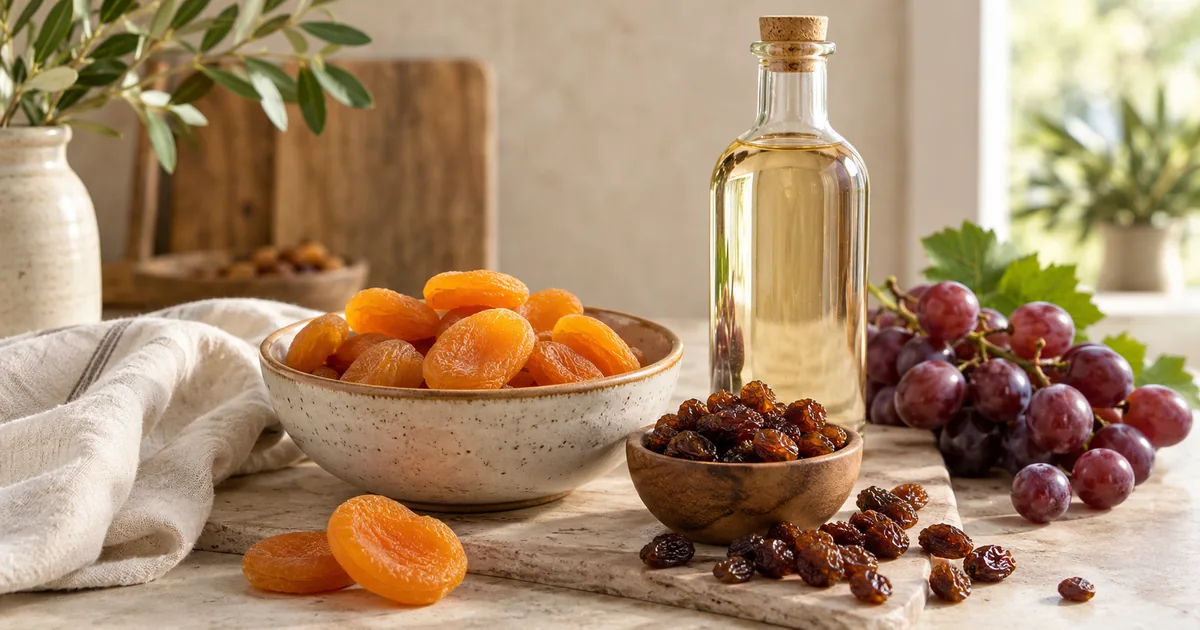
The UK Whitworths Amazing Apricots page, checked on October 1, 2026, describes the product as suitable for vegans. Its ingredient information includes partially rehydrated dried apricots, potassium sorbate and sulphur dioxide, with the sulphur dioxide emphasised.
There is no contradiction between those statements. The vegan claim concerns animal-derived materials; the sulphur dioxide declaration serves a different purpose. Our preservatives guide also explains potassium sorbate. This is a manufacturer's published-label example, not a physical-pack inspection or laboratory test.
It also does not mean every dried-fruit snack is vegan. A mixed snack can have yogurt pieces, chocolate coatings or honey. For a new bag, read all the additions, not just the fruit name or preservative. Our hidden animal ingredients guide helps with the less obvious names.
Why a wine can contain sulphites and still need a vegan check
Wine has a second issue: how it was made. A bottle can contain sulphites and be vegan, or contain sulphites and have involved animal-derived processing aids. The warning does not distinguish between those situations.
The Australian Wine Research Institute's fining guidance describes materials used to clarify wine, including animal-derived options. That is the sourcing question to investigate. Our wine and fining guide explains it in detail; isinglass is one example worth recognising.
When asking a winery, include the wine name, vintage and country of sale. Ask whether animal-derived ingredients or processing aids were used. “Does it contain sulphites?” will not get you the answer you need about vegan production.
Does “no added sulphites” mean vegan?
No. It describes the addition of sulphites, not the use of animal materials. The AWRI's discussion of wine components also notes that sulphur dioxide can arise during fermentation. “No added” should not be silently read as “none present.”
Keep the same discipline with words such as organic or natural: they answer different questions from a specific vegan production statement. If you are shopping for someone else, it is better to ask which assurance they want than to guess from front-label wording.
A short shopping check
- Identify the product and market. Match the exact variety and, for wine, vintage where relevant.
- Read ingredients and dietary claims separately. Do not treat a sulphite declaration as an animal warning.
- Check the unresolved issue. For a snack it might be a coating; for wine it might be the fining method.
- Keep medical questions separate. A vegan label or app result is not an allergen-free guarantee.
The same separation helps with other packaging language. Our guide to “may contain milk” explains why cross-contact text and deliberate ingredients should not be mixed together.
Common questions
Are sulphites vegetarian?
They are generally suitable for vegetarians as well as vegans. The rest of the food or drink still needs its own assessment.
Is sulphur dioxide E220 animal-derived?
It is not an animal ingredient in the way gelatin or milk protein is. E220 alone is not a reason to reject a food on vegan grounds.
Can the app tell me how much sulphite is present?
No. A barcode or ingredient photo cannot measure a chemical concentration. Use the manufacturer's information and appropriate professional guidance if that amount matters to you.
Sources and editorial scope
Published October 1, 2026. UK and US label rules were checked against the linked official guidance; the food example is limited to the named manufacturer's UK page. Prepared by VeganCheckr with AI-assisted drafting and an AI editorial review for accuracy, clarity and repetition. No independent human, clinician or laboratory review is claimed.
Check the label on your own product
VeganCheckr scans barcodes and ingredient labels, flags hidden animal ingredients and E-numbers, and shows you the evidence. Free to download on the App Store and Google Play. Optional Premium features vary by platform.

 Scan with your iPhone camera