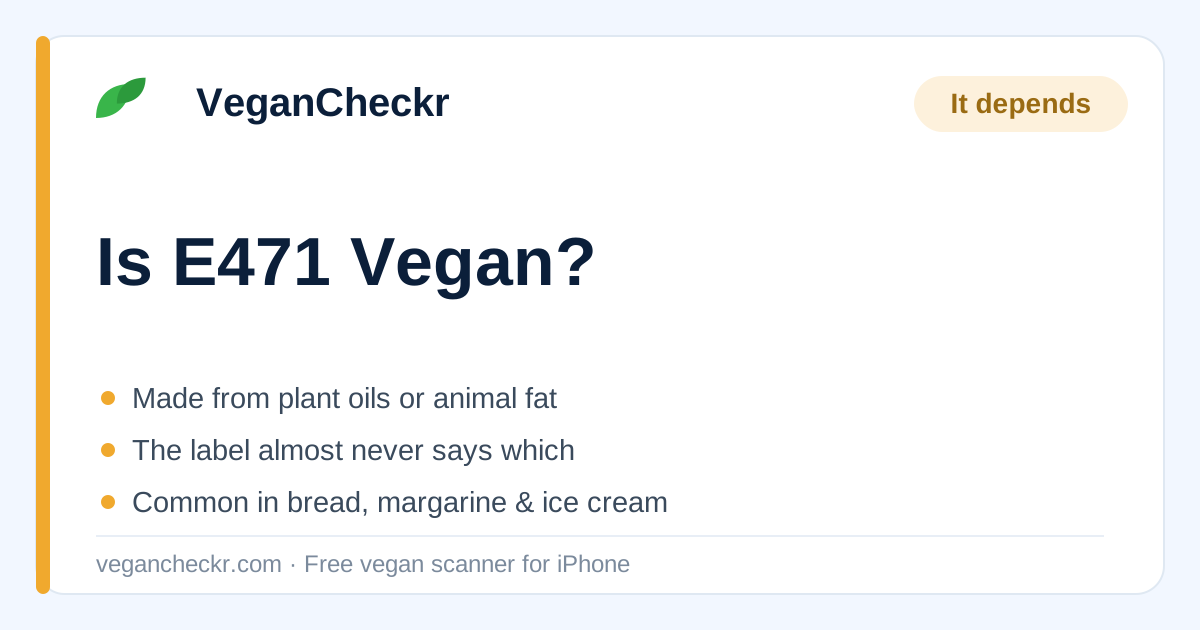
? It depends E471 (INS 471) is sometimes vegan. Mono- and diglycerides can be made from plant oils (palm, soy, sunflower) or from animal fats like beef tallow and pork lard. The ingredient label almost never tells you which. Without a vegan mark or a source declaration, you can't be sure.
INS 471: is it vegetarian, and which animal is it from?
E471 is vegetarian only when its fatty acids come from plant oils or the manufacturer confirms a non-animal source. E471 made from animal fat is not vegetarian. If the label gives no source and the product has no vegetarian or vegan certification, the honest verdict is uncertain rather than automatically vegetarian.
INS 471 does not name an animal. It identifies the additive, not whether a supplier used plant oil, beef fat or pork fat. It would be inaccurate to describe all INS 471 as pork-derived, or to assume it is vegetable-derived because the food looks vegetarian.
What evidence actually settles E471?
| What you can see | What you can conclude |
|---|---|
| E471 or INS 471, with no source | The source is unknown; the number alone cannot establish vegan or vegetarian status. |
| E471 explicitly identified as vegetable-derived | This additive's source is plant-based. The rest of the product still needs checking. |
| Current vegan certification for the exact product | Useful evidence covering the product under that scheme's criteria. |
| Vegetarian label only | Relevant to animal-fat sourcing, but the recipe may still contain dairy, egg or honey. |
| A scanner finds no animal ingredient | Not proof of an undisclosed E471 source. Check the underlying product evidence. |
That "it depends" is why E471 deserves a closer look. It sits in sandwich bread, margarine and ice cream, doing its job invisibly — until you try to work out whether it came from a plant or an animal. This guide explains what E471 is, why the label usually cannot answer the source question, and the practical ways to get a real answer.
What is E471, exactly?
E471 is the European code for mono- and diglycerides of fatty acids; the International Numbering System calls the same additive INS 471. Chemically, it's a glycerol molecule bonded to one (mono) or two (di) fatty acid chains. One end of the molecule likes water, the other likes fat, which lets it hold oil and water together in mixtures that would otherwise split.
That one trick makes it everywhere-useful: it keeps sliced bread soft, stops margarine separating, keeps ice cream smooth, and prevents the oil slick on top of cheap peanut butter. In the EU it's authorised under Regulation (EC) No 1333/2008, and EFSA re-evaluated it in 2017 and found no safety concern: your gut simply breaks it back down into glycerol and fatty acids. In the US the same substance is affirmed as GRAS (generally recognised as safe) under 21 CFR 184.1505 and appears on labels as "mono- and diglycerides" rather than E471.
Notice what's missing from all of that: regulators approve additives on safety, not source. Which brings us to the problem.
Where E471 comes from: plant oils or animal fat
The fatty acids in E471 come from edible fats or oils. The EU's current E471 specification defines a mixture of glycerol esters made from fats and oils that meet food-safety requirements, but it does not require those inputs to be botanical. Plant oils and animal fats can therefore both fit the legal definition. The regulation does not publish a market-share split, so claims that an unlabelled E471 is “usually plant-based” cannot settle the status of the product in your hand.
Here's the part that matters for vegans: once the fat has been processed into mono- and diglycerides, the plant version and the animal version are chemically identical. Taste, texture and a barcode do not tell a shopper which raw material was used. A manufacturer's supplier records or product certification are the practical ways to establish the source.
This is why vegan and vegetarian organisations consistently list E471 among the additives that may be animal-derived, alongside its close relatives E472(a–f), which are modified esters of the same molecule. E-numbers that are not vegan carries the full list, the E472 family included.
Why the label can't tell you the source
Neither EU nor US labelling law requires a manufacturer to declare the origin of an additive. EU rules require allergens to be emphasised in the ingredient list. But beef tallow and pork lard aren't allergens, so E471 made from either is listed simply as "emulsifier: E471" or "mono- and diglycerides of fatty acids". Legally complete, practically useless.
There are two happy exceptions. Some brands voluntarily print "mono- and diglycerides of fatty acids (vegetable)" or "of plant origin". That's a genuine source declaration and you can trust it. A current vegan certification is useful evidence about additive sourcing. A religious certification should not be substituted for a vegan claim: it follows different criteria and does not by itself establish the whole product as vegan.
This same source question appears on some current Pringles labels, which is one reason the flavor and country must be checked instead of treating a brand name as a vegan verdict.
If the label just says "E471" with no source, no vegan mark, and no answer on the company's website, you're being asked to guess what an animal-or-plant molecule was made from. You don't have to guess.
 Check it in seconds with VeganCheckr
Instead of memorizing which E-numbers are ambiguous, let the scanner flag them for you:
- Open VeganCheckr and tap Scan, then point your camera at the product's barcode.
- Review any flagged additive and the evidence available for that exact product.
- Compare the result with the current pack. If the E471 source is absent from both, keep it unknown and ask the manufacturer.
Which foods contain E471?
E471 is one of the most common additives in the supermarket. If a product is soft, spreadable, creamy or long-lasting, there's a fair chance it's in there. These are the categories where you'll meet it most often:
| Food | What E471 does there | How often you'll see it |
|---|---|---|
| Sliced bread, buns & bagels | Softens the crumb, slows staling | Very common (see is bread vegan?) |
| Tortillas & wraps | Keeps them flexible and rollable | Very common |
| Margarine & spreads | Stops the water and oil splitting | Very common |
| Ice cream & frozen desserts | Smooth texture, controls ice crystals | Very common |
| No-stir peanut butter | Prevents the oil separating on top | Common in budget brands |
| Cakes, pastries & packaged bakes | Volume, softness, longer shelf life | Very common |
| Coffee creamers & whipped toppings | Stable foam and creamy mouthfeel | Common |
| Chocolate & candy | Texture and anti-sticking | Occasional; E322 lecithin is more typical |
The pattern is worth noticing: E471 clusters in exactly the products that vegans often assume are safe: bread, wraps, dairy-free spreads, sorbets. It's one of the classic hidden animal ingredients precisely because nothing about the food looks animal-derived.
Do halal and vegan labels answer the same question?
No. Halal certification and vegan certification follow different standards. The E471 code alone does not establish either. For halal suitability, check the exact product with a recognised certifier; for vegan suitability, establish that no animal-derived inputs were used.
A confirmed vegetable source answers the animal-fat question for this additive. It does not automatically certify the entire food as halal, vegan or suitable for an allergy.
How to check whether the E471 in your product is vegan
In order of reliability, here's what actually works:
- Look for a source declaration. "Mono- and diglycerides of fatty acids (vegetable)" or "(plant-based)" settles it.
- Look for a vegan trademark. Certification covers additive sourcing, which is exactly the part you can't see.
- Check the manufacturer's website or FAQ. Look for a current statement covering the exact product and country of sale.
- Use a scan to assist the check. A scanner can highlight an uncertain additive, but it cannot supply an origin missing from the label and database. Manufacturer confirmation remains necessary when the source is unresolved.
A useful manufacturer question: “Could you confirm whether the E471 / mono- and diglycerides in [product, barcode and country] are entirely vegetable-derived, including the glycerol and fatty acids? Does that answer cover the current recipe and suppliers?” If the reply only says the product is safe or contains no pork, it has not answered the vegan sourcing question.
Step 1 gets easier with practice, and reading food labels as a vegan collects the other traps worth knowing: "natural flavors", whey in unexpected places, and the E-numbers with no plant version at all, like E120 carmine.
No barcode? Scan the ingredient list instead
Imported products, bakery items and market finds often have a printed label but no scannable barcode. VeganCheckr handles that too:
- Open VeganCheckr and choose the ingredient label scan to photograph the printed list.
- The app reads the label and flags E471, E472 and other ambiguous or animal-derived additives, with the evidence listed.
- Add mono- and diglycerides to your personal avoidance alerts if you'd rather skip every "maybe" automatically.
E202, E415 and E471: why the verdicts differ
These three codes often appear together, but they describe different substances. E202 is potassium sorbate, a manufactured preservative that is generally vegan. E415 is xanthan gum, a thickener produced by microbial fermentation and also generally vegan. E471 is the uncertain one because its fatty-acid source can be plant or animal. Seeing E202 or E415 beside it does not confirm where the E471 came from.
| Additive | What it is | Vegan? |
|---|---|---|
| E202 | Potassium sorbate preservative | Generally vegan: manufactured rather than sourced from animal fat |
| E415 | Xanthan gum thickener made by microbial fermentation | Generally vegan |
| E471 / INS 471 | Mono- and diglycerides of fatty acids | Maybe: plant or animal fat; label rarely says |
| E472a–f | Esters of mono- and diglycerides | Maybe: same source ambiguity as E471 |
| E322 (lecithin) | Emulsifier from soy, sunflower or egg | Usually: soy/sunflower dominate; egg lecithin exists |
| E120 (carmine) | Red dye from cochineal insects | Never |
| E904 (shellac) | Glaze from lac insect secretions | Never |
Frequently asked questions
Is E471 always made from animal fat?
No. E471 can be made from edible plant oils or animal fats. EU specifications define its chemistry and food-safety requirements but do not identify a botanical or animal source. Because recipes and suppliers vary, an unsourced E471 label remains ambiguous.
Is E471 halal?
The code alone does not establish halal suitability. Check the exact product and its certification with a recognised halal authority. A vegetable source answers the animal-fat question but does not certify the whole food.
What is the difference between E471 and E472?
E472 (a to f) covers esters of mono- and diglycerides, chemically modified versions of E471 used for similar jobs in baking and margarine. They raise exactly the same question: the fatty acids can come from plant oils or animal fat, and the label rarely says which.
Are mono- and diglycerides on a US label the same as E471?
Yes. The US does not use E-numbers, so American labels list the additive by name, usually as mono- and diglycerides or monoglycerides. It is the same substance with the same source ambiguity, and it is affirmed as GRAS by the FDA under 21 CFR 184.1505.
Is E471 safe to eat?
Yes, as far as regulators are concerned. EFSA re-evaluated E471 in 2017 and found no safety concern; your body breaks it down into glycerol and fatty acids, the same components as ordinary dietary fat. Safety and vegan status are separate questions, though.
Check any product in seconds
VeganCheckr scans barcodes and ingredient labels, flags hidden animal ingredients and E-numbers, and shows you the evidence. Free to download on the App Store and Google Play. Optional Premium features vary by platform.

 Scan with your iPhone camera