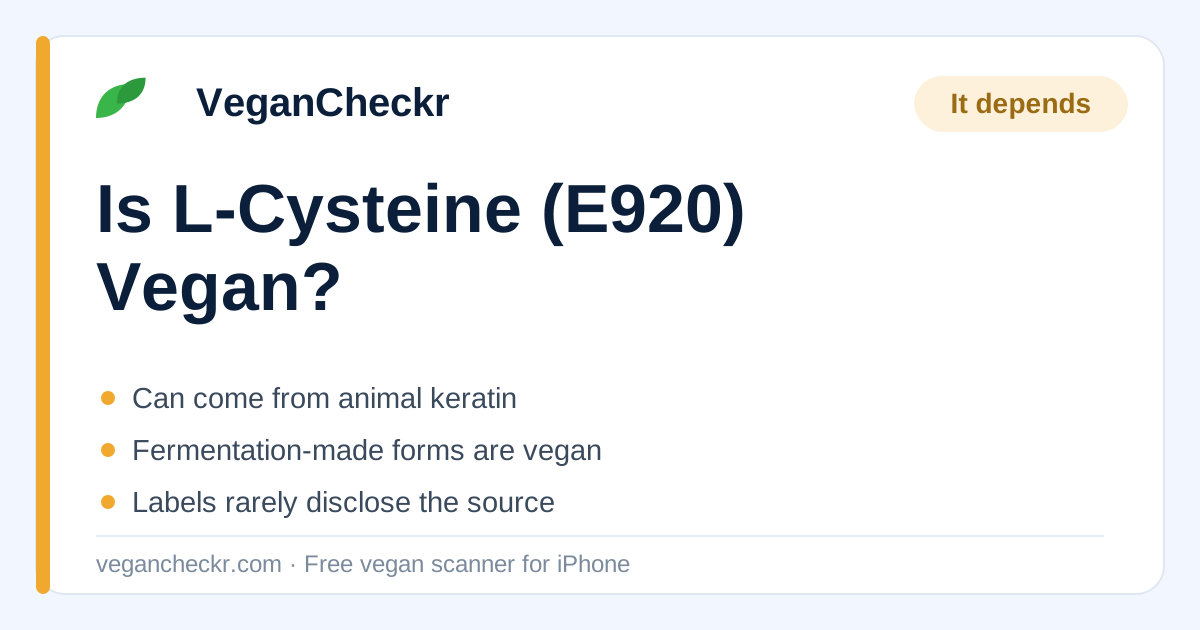
? It depends L-cysteine (E920 or INS 920) is vegan only when it is made without animal-derived raw materials. Commercial production includes an older extraction route that starts with keratin-rich material and a fermentation route that can start with plant-derived glucose. “L-cysteine” on an ingredient list does not disclose which route supplied that batch, so a source statement, manufacturer answer or vegan certification is needed.
This is an ingredient where accuracy matters more than a dramatic headline. Human hair has a long association with cysteine production, but current EU specifications expressly say it may not be used as an E920 source. Animal-derived routes have not therefore disappeared from every market, and fermentation-made E920 is also a real commercial product. Public evidence does not establish one reliable worldwide percentage for either route, so this guide does not pretend that every unknown batch has the same origin.
What is L-cysteine?
L-cysteine is a sulfur-containing amino acid. It occurs naturally as part of proteins in humans, animals, plants and microorganisms. In food manufacturing, a purified form can be used as a flour treatment agent or dough conditioner. It is listed as L-cysteine, E920, INS 920, or sometimes with a form such as L-cysteine hydrochloride.
Its job in dough comes from chemistry rather than source. Bread dough gains strength from bonds within its gluten network. Cysteine can help rearrange those bonds, making the dough more extensible and easier to process. An industrial baker can then reduce mixing demands and handle dough more consistently through dividing, shaping and other machinery.
That function explains why E920 is associated with soft packaged loaves, bagels, buns, pizza bases and other high-throughput bakery products. It is not required to make bread. Flour, water, yeast and salt already make a loaf, as our broader guide to vegan bread explains.
The source decides whether E920 is vegan
The purified L-cysteine molecule performs the same food function whichever process made it. A standard ingredient name therefore cannot preserve the supply-chain history a vegan shopper actually wants to know.
| Production route | Starting point | Vegan verdict | Evidence to look for |
|---|---|---|---|
| Keratin hydrolysis and purification | Keratin-rich animal material can be used | Not vegan; not vegetarian when the source is animal | Supplier origin statement |
| Microbial fermentation | Producer-specific nutrient feedstock; commercial plant-glucose processes exist | Can be vegan | “Fermentation-derived,” “non-animal” or vegan certification |
| Bare ingredient listing | Not stated | Uncertain | Ask the product maker to trace its additive supplier |
A useful primary example comes from a producer rather than a marketing blog. WACKER describes its fermentation process for cysteine as using glucose of plant origin with microorganisms, and identifies the resulting food ingredient as suitable for vegan products. Its corporate sustainability report likewise says this route uses plant-based and inorganic raw materials instead of material such as hair or feathers. That proves a commercially established vegan route exists. It does not prove that every supplier uses it.
Conversely, an additive permitted from a natural protein source is not automatically vegan. The finished molecule may be highly purified, but vegan status follows the material and process used to make it, not whether an animal species can be detected from the chemical name.
Is E920 vegetarian?
E920 is vegetarian when it is fermentation-derived without animal inputs; animal-keratin-derived E920 is not vegetarian. The same evidence standard works for both vegetarian and vegan shopping. A code on its own is inconclusive, while a certified vegetarian or vegan mark covers the product’s particular supply chain.
Some people use a vegetarian definition that allows dairy and eggs. That distinction does not rescue cysteine obtained from animal tissue: keratin material is neither dairy nor egg. If the manufacturer cannot identify the source, the honest verdict is “unverified,” not “definitely animal” and not “definitely vegetarian.”
What the EU rule actually says about human hair
The online claim that “E920 is made from human hair” needs a date and a market attached to it. In the European Union, the food-additive purity specification in Commission Regulation (EU) No 231/2012 explicitly excludes human hair as a source for L-cysteine. Food-grade E920 that complies with that specification cannot lawfully use human hair.
That sentence answers one narrow question. It does not say E920 must be plant-derived, it does not turn every E920 product into a vegan product, and it does not automatically govern supplements, cosmetics or foods made for another jurisdiction. It also does not give shoppers a global production breakdown.
The careful conclusion is therefore:
- EU food E920: human hair is prohibited as a source, but “E920” alone is still not a plant-origin declaration.
- Fermentation-certified E920: can be vegan when the producer confirms non-animal raw materials and processing.
- Unknown-market or unknown-source E920: requires verification rather than a guess.
“Human hair is prohibited” and “the additive is vegan” are not equivalent statements. The first removes one possible source; the second requires a positive account of the source actually used.
How E920 may appear on an ingredient list
Depending on country and labelling convention, look for:
- L-cysteine;
- E920 or INS 920;
- L-cysteine hydrochloride;
- L-cysteine hydrochloride monohydrate;
- flour treatment agent (L-cysteine);
- dough conditioner, followed by L-cysteine in brackets.
The words “amino acid” do not settle the origin. Plants, animals and microbes all contain amino acids, and food manufacturers can produce the same defined compound by different routes. The situation resembles source-dependent E471 mono- and diglycerides: the label tells you what the additive is, while the supplier knows what it came from.
Do not confuse L-cysteine with cystine, the paired form made when two cysteine molecules join, or with N-acetyl-L-cysteine (NAC), a related ingredient found mainly in supplements and medicines. A source answer for one product does not automatically cover another chemical form or supplier.
Foods most worth checking
Not every loaf contains E920, and ingredient practices differ considerably by manufacturer and market. The following categories are sensible places to look rather than proof that the additive is present:
- soft packaged sandwich bread and long-life rolls;
- commercial bagels, burger buns and hot-dog buns;
- premade pizza crusts, dough balls and bakery mixes;
- large-scale pastries or laminated dough products;
- flour improver and dough-conditioner blends sold to bakeries.
A bakery counter without a printed label can still provide an allergen or product specification sheet. Ask for the complete ingredients, not only whether the bread “contains dairy.” Milk, whey, eggs, honey and source-dependent emulsifiers are separate issues, while E920 may sit inside a flour treatment or improver blend.
 Flag source-dependent additives before checkout
Use VeganCheckr to turn a long bakery label into a short review list:
- Scan the barcode or photograph the full ingredient panel.
- Open the E920 explanation instead of treating every amino acid as the same.
- Confirm the source with the brand, then save the product for the next shop.
How to ask a manufacturer about L-cysteine
A broad “Is this vegan?” question can produce a cautious non-answer, especially when a company has not certified the product. Ask for the fact its technical team can trace:
Does the L-cysteine (E920) in this specific product come from animal keratin, or is it made by fermentation or another process using no animal-derived raw materials or processing aids?
Include the product name, flavour, country of purchase and lot code if available. Recipes and additive suppliers can differ between markets. A useful answer names fermentation, vegetable glucose, non-animal origin or the raw-material class. “The finished additive contains no animal protein” is less useful because purification does not answer where production began.
If the company cannot trace the source, choose a product with a clear vegan mark or a simpler formulation. A recognised certification is stronger than an assumption based on brand reputation. Our vegan food-label guide explains how certification, allergen statements and voluntary source claims fit together.
A five-step E920 decision
- Confirm that E920 is actually present. Do not infer it from texture or from “flour improver” unless a full specification names it.
- Look for a vegan certification. A certification on the same product and current recipe is the quickest positive evidence.
- Look for origin wording. Fermentation-derived, vegetable-glucose, non-animal or vegan-grade language is useful when it comes from the manufacturer or supplier.
- Do not use geography as a shortcut. The EU human-hair ban removes one source but does not require every E920 batch to be plant-derived.
- Ask or choose an alternative. The vegan ingredient checker helps you evaluate the rest of the label at the same time.
This approach also works for the wider list of hidden animal ingredients. Some names reliably identify an animal source, while others identify a molecule that needs a supply-chain answer. E920 belongs firmly in the second group.
Frequently asked questions
Is L-cysteine from feathers vegan?
No. If the raw material is poultry feathers or another animal keratin, the resulting additive is not vegan or vegetarian, even though purification produces the same L-cysteine molecule as fermentation.
Is fermentation-derived L-cysteine vegan?
It can be. A documented process using plant-derived glucose and no animal-derived processing aids is vegan. Look for that confirmation from the supplier, product maker or a credible certification rather than assuming every fermentation process is identical.
Is E920 made from human hair in Europe?
It should not be. The EU food-additive specification expressly states that human hair may not be used as the source. That rule does not by itself prove plant origin, so the vegan question still needs a positive source statement.
Does organic bread contain L-cysteine?
Organic rules and formulations vary by jurisdiction, so the word “organic” is not a universal E920 answer. Read the current ingredient list and rely on vegan certification if the source is not disclosed.
Can a label test tell whether E920 came from an animal?
The ingredient name cannot. Source verification normally comes from documentation within the manufacturer’s supply chain. That is why a precise supplier question or audited vegan certification is more useful than inspecting the code alone.
Check any product in seconds
VeganCheckr scans barcodes and ingredient labels, flags hidden animal ingredients and E-numbers, and shows you the evidence. Free to download on the App Store and Google Play. Optional Premium features vary by platform.

 Scan with your iPhone camera