✓ Generally vegan Xanthan gum, E415 or INS 415 is generally vegan and vegetarian. Official standards define it as a polysaccharide made when Xanthomonas campestris bacteria ferment carbohydrate. It is not gelatin and does not require an animal ingredient. Check the product separately for milk, egg, honey or other non-vegan ingredients.
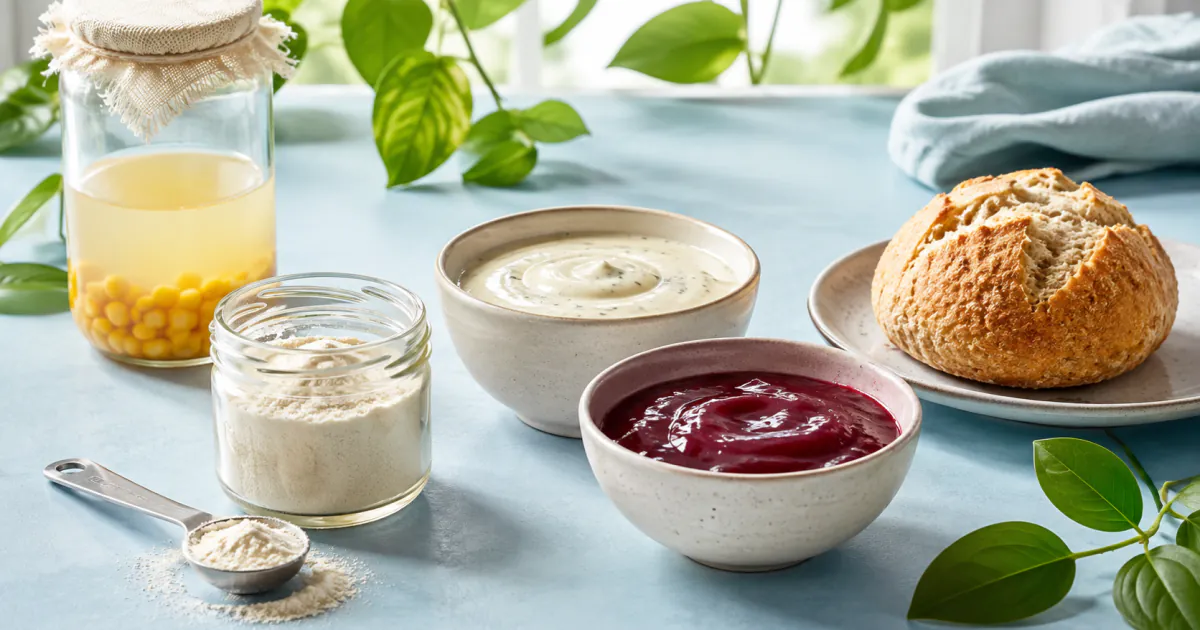
Is INS 415 vegetarian? Is it the same as E415?
Yes. INS 415 and E415 refer to xanthan gum, which is generally suitable for vegetarians and vegans. The FAO/WHO specification linked below identifies INS 415 as a carbohydrate gum made by bacterial fermentation, not animal collagen. The different numbering prefixes do not imply different ingredients.
On a label, “thickener 415”, “stabiliser E415” and “xanthan gum” point to the same ingredient. This is a verdict about the additive, not the full food: a sauce can use vegan xanthan gum alongside milk, egg or fish.
If E415 appears with E471 or E627, E631 or E635, assess each code separately. Xanthan's fermentation route does not settle the sourcing of an unrelated emulsifier or flavour enhancer.
What xanthan gum is
Xanthan gum is a large carbohydrate molecule, or polysaccharide, that dissolves in water and makes liquids more viscous. A small amount can keep particles suspended, hold oil and water mixtures together, improve dough structure or stop a sauce separating in the bottle. On European labels it may appear as “xanthan gum” or “stabiliser: E415.” Codex uses the matching number INS 415.
The official FAO/WHO JECFA specification for xanthan gum defines it as a high-molecular-weight gum produced by pure-culture fermentation of a carbohydrate with Xanthomonas campestris. After fermentation, the gum is recovered with ethanol or isopropanol, dried and milled. The specification lists thickening, stabilising, emulsifying and foaming among its functions.
That description matters more than the odd-sounding name. “Xanthan” refers to the microorganism associated with production; it is not an animal tissue, dairy protein or secreted animal product. Bacteria are not animals, and using microorganisms for fermentation is compatible with ordinary vegan standards, just as yeast fermentation is.
How E415 is made
- A carbohydrate solution is prepared. The production culture needs a sugar source. FDA’s scientific review describes glucose or sucrose as production inputs.
- The bacteria ferment it. A controlled culture of Xanthomonas campestris builds and releases the xanthan polysaccharide into the liquid.
- The gum is separated and purified. Alcohol recovery precipitates the gum so it can be collected away from the fermentation liquid.
- It is dried and milled. The finished food-grade material becomes a cream-coloured, water-soluble powder.
The US rule at 21 CFR 172.695 likewise defines xanthan gum as a polysaccharide derived from Xanthomonas campestris by pure-culture fermentation and requires production to leave no viable cells of the organism. The FDA also lists it among microbial-derived ingredients used in food.
What the current EU specification confirms
The EU updated its E415 specification in 2026. Commission Regulation (EU) 2026/196 still defines xanthan gum through pure-culture carbohydrate fermentation, then adds tighter requirements around the identity of the production strains. It requires qualifying Xanthomonas campestris strains and says the finished product must show no residual enzyme activity.
Those technical controls do not create the vegan verdict, but they make the manufacturing description unusually clear for an E-number. The EU definition describes a fermented polysaccharide, purification with ethanol or propan-2-ol, drying and milling. It does not define E415 as milk-derived, animal-derived or extracted from animal tissue.
Older stock produced under the previous specification may still circulate during the regulation’s transition. That does not reverse the sourcing conclusion: the earlier EU and JECFA definitions also used carbohydrate fermentation with Xanthomonas campestris. The 2026 change mainly tightens microbiological characterisation rather than replacing an animal process.
Xanthan gum is the purified result of fermentation, not an animal gum and not a live bacterial culture in the food.
Does the fermentation carbohydrate matter?
Online ingredient lists sometimes claim that xanthan gum is secretly dairy-derived because a fermentation could theoretically use a milk-based nutrient. That claim goes beyond what the name E415 tells us. The JECFA standard says carbohydrate; FDA’s review describes glucose or sucrose. Neither official definition identifies milk as the standard source of xanthan gum.
It is still reasonable to distinguish a vegan sourcing question from an allergy question. A person avoiding animal use can treat standard food-grade xanthan gum as vegan. A person with a severe milk, wheat, corn or soy allergy needs evidence about the supplier’s production and cross-contact controls, not a general vegan verdict. Vegan does not mean free from every allergen.
If a package carries a precautionary allergen warning, follow it according to your allergy plan. If a supplier markets a xanthan powder as allergen-free or gluten-free, assess that exact claim and its certification. The ingredient’s fermentation origin cannot guarantee the handling conditions of every factory that later repacks or uses it.
Xanthan gum compared with similar ingredients
| Ingredient | What it is | Typical source | Vegan status |
|---|---|---|---|
| Xanthan gum (E415) | Fermented polysaccharide | Bacterial fermentation of carbohydrate | Generally vegan |
| Guar gum (E412) | Seed polysaccharide | Guar beans | Vegan |
| Locust bean gum (E410) | Seed polysaccharide | Carob seeds | Vegan |
| Agar (E406) | Gelling polysaccharide | Red algae | Vegan |
| Gelatin (E441) | Animal collagen protein | Animal skin, hides and bones | Not vegan or vegetarian |
The comparison explains why texture is a poor shortcut. Two ingredients may both thicken a dessert while coming from entirely different biological sources. Xanthan behaves more like plant and microbial hydrocolloids than animal-derived gelatin. Our E-number guide separates clear, source-dependent and animal-derived additives without judging them by function alone.
Where vegans are likely to find xanthan gum
E415 is especially useful where a recipe needs body or stability without egg, gelatin or a large amount of starch. It commonly appears in:
- gluten-free breads, cakes, pastry mixes and pizza bases;
- salad dressings, ketchup, chilli sauces and plant-based mayonnaise;
- non-dairy drinks, cream alternatives and frozen desserts;
- soups, gravies, ready meals and meat alternatives;
- drink powders, syrups and some supplements.
Its presence does not certify the surrounding recipe. A sauce with xanthan may still contain anchovy, honey or milk. A gluten-free loaf may use egg for structure. A frozen dessert may contain dairy even though the stabiliser itself is vegan. Apply the verdict to E415, then continue through the list.
 Clear E415, then check the whole formula
VeganCheckr can scan a barcode or ingredient label and explain unfamiliar names in context:
- Recognise xanthan gum, E415 and INS 415 as the same generally vegan additive.
- Review the rest of the product for clear animal ingredients and genuinely source-dependent additives.
- Open the supporting explanation when a label term needs more than a red or green flag.
How to read E415 on a product label
- Match the names. Xanthan gum, E415 and INS 415 identify the same additive.
- Clear the additive. Standard food-grade xanthan gum is a fermentation-made polysaccharide and is generally vegan and vegetarian.
- Check the rest of the recipe. Dairy, egg, honey, gelatin and broad flavour declarations are separate questions.
- Keep allergy warnings separate. Precautionary statements concern cross-contact and personal safety, not whether E415 itself is animal-derived.
- Ask only when your standard requires it. If you need documented substrate or allergen controls, contact the manufacturer of the exact product or choose suitable certification.
The same evidence ladder works for many fermented ingredients. The lactic acid guide explains another name that sounds animal-derived even though the modern ingredient is normally made by microbial fermentation. For a repeatable shopping routine, follow our vegan label-reading guide.
Food safety and vegan status are different
JECFA records an acceptable daily intake of “not specified” for xanthan gum, and US rules permit it for functions including stabilising, emulsifying and thickening under good manufacturing practice. That regulatory conclusion is about permitted use and safety at intended levels. It does not make every E415-containing food nutritionally ideal, and it is not the reason the ingredient is vegan.
Individual tolerance and clinical-diet rules are health questions, not sourcing verdicts. Anyone managing symptoms, a diagnosed allergy or a prescribed diet should use qualified medical guidance and the information for the exact product rather than applying this general vegan classification as medical advice.
Frequently asked questions
Is xanthan gum made from animals?
No animal tissue is part of the official definition. Xanthan gum is a polysaccharide made by bacterial fermentation of carbohydrate, then separated, dried and milled. Standard food-grade E415 is generally considered vegan and vegetarian.
Is xanthan gum dairy-free?
Xanthan gum itself is not a milk ingredient or milk protein. If dairy allergy safety matters, check the exact package for milk ingredients and precautionary warnings and ask the supplier about production controls when necessary. A vegan verdict alone is not an allergen-free guarantee.
Is E415 the same as gelatin?
No. E415 is a fermentation-made carbohydrate gum. Gelatin, commonly associated with E441, is collagen from animal tissues and is not vegan or vegetarian. They can perform similar texture jobs but have unrelated sources and chemistry.
Is xanthan gum gluten-free?
Pure xanthan gum is not gluten and is widely used to replace gluten’s structural role in baking. People who need strict gluten avoidance should still choose a product with suitable gluten-free controls or certification because packing and manufacturing cross-contact are product-specific.
Do vegans need to contact every manufacturer about xanthan gum?
No. The official production definition and common glucose-or-sucrose fermentation route support treating ordinary food-grade E415 as vegan. Contact the supplier only if you follow a stricter documented-source standard or need allergen information that the label does not provide.
Check any product in seconds
VeganCheckr scans barcodes and ingredient labels, flags hidden animal ingredients and E-numbers, and shows you the evidence. Free to download on the App Store and Google Play. Optional Premium features vary by platform.

 Scan with your iPhone camera