✓ Vegan Yeast is vegan. It is a fungus, not an animal, and common baker’s, brewer’s and nutritional yeasts do not require animal ingredients by definition. Check flavored blends, fortified products and the finished food separately because milk, honey, animal-derived vitamins or processing aids can appear around the yeast.
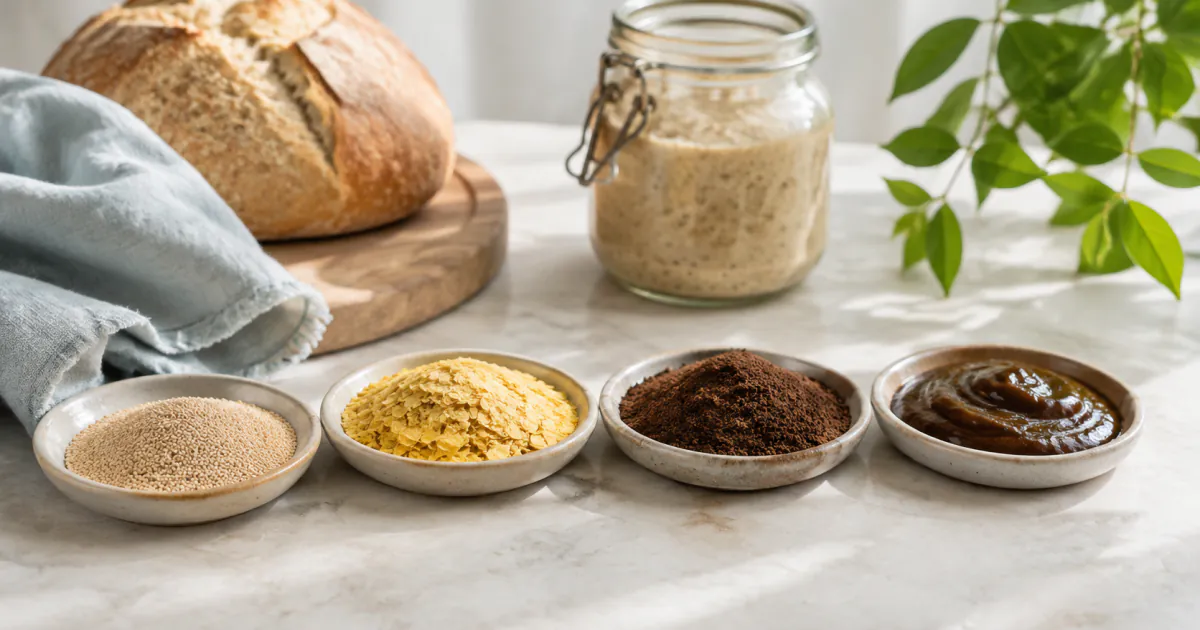
Why living yeast is still vegan
Vegan eating excludes ingredients derived from animals. Yeast belongs to the fungi, a separate biological kingdom. The US National Center for Biotechnology Information places Saccharomyces cerevisiae, the species commonly associated with baking and brewing, within the fungal lineage. It is neither a plant nor an animal.
Being alive is not the dividing line. Plants, fungi and many microbes are alive too. The Vegan Society's own baking guidance directly states that yeast is suitable for vegans and identifies it as a fungus. That makes ordinary yeast a clear answer, not a borderline ingredient.
Yeast is vegan because it is a fungus, not because it is inactive or unable to feel.
Baker’s, brewer’s and nutritional yeast compared
| Type | Active? | Main use | What to check |
|---|---|---|---|
| Fresh baker’s yeast | Yes | Leavening bread and dough | Usually a single vegan ingredient |
| Active dry yeast | Yes | Home and commercial baking | Added processing aids in specialty blends |
| Instant yeast | Yes | Fast, direct-mix dough | Same label check as active dry yeast |
| Brewer’s yeast | Active in brewing; supplements are often inactive | Fermentation or dietary supplement | Carrier ingredients and finished beer processing |
| Nutritional yeast | No | Savory flakes, powder or seasoning | Fortification and added flavors |
| Yeast extract | No | Concentrated savory flavor | The complete spread, stock or snack formula |
These names describe how the yeast is selected, handled and used. They do not move it into the animal kingdom. Lesaffre, a major yeast producer, describes nutritional yeast as a deactivated form of Saccharomyces cerevisiae and contrasts it with the active form used to ferment bread dough and brewery wort.
Is baker’s yeast vegan?
Yes. Fresh, active dry and instant baker’s yeast are vegan. The microorganisms consume sugars in dough and release carbon dioxide, which expands the dough. Killing yeast during baking does not create an animal-welfare issue because yeast is fungal life.
Do not transfer that verdict to the whole loaf. Bread can contain milk, butter, egg, honey, whey, cheese or a dough conditioner whose source needs checking. Our guide to whether bread is vegan covers the finished-product check, while the L-cysteine guide explains one conditioner that can have different sources.
A packet simply labeled “active dry yeast” or “instant yeast” is normally straightforward. Specialty bread-machine mixes and improvers may combine yeast with emulsifiers, enzymes or conditioners. Read those as multi-ingredient products rather than treating every component as yeast.
Is brewer’s yeast vegan?
Brewer’s yeast itself is vegan. It ferments sugars into alcohol and carbon dioxide, and spent yeast can be collected and sold as an inactive supplement. A supplement may include vitamins, flavorings, binders or capsule material, so its label still matters.
Beer is a separate verdict. Some producers use animal-derived fining agents after fermentation even though the yeast is vegan. Isinglass, made from fish swim bladders, is the best-known example. Check the brand or brewery using our guides to vegan beer and isinglass.
“Brewer’s yeast” on a supplement does not mean the product contains alcohol. The yeast may be a separated and dried ingredient. Conversely, the presence of vegan yeast does not prove that the beer was processed without animal products.
Is nutritional yeast vegan?
Plain nutritional yeast is vegan. It is cultivated, harvested, deactivated by heat and sold as flakes or powder for its savory flavor. It does not make dough rise because the cells are no longer active. “Nooch” is only a nickname for nutritional yeast.
Flavored nutritional-yeast seasonings need the normal full-label check. A product marketed as “cheesy” can be dairy-free, but that description is not proof. Look for milk, whey, casein, lactose and cheese powder, particularly in seasoning blends where nutritional yeast is one of several ingredients.
 Check the blend around the yeast
Scan or paste a bread mix, seasoning or supplement ingredient list into VeganCheckr on iPhone. The app can distinguish yeast from named milk, honey and animal-derived additives, then show which uncertain ingredients may need a manufacturer answer.
Get VeganCheckr for iPhone or AndroidDoes nutritional yeast always contain vitamin B12?
No. Vitamin B12 is added to some nutritional yeasts, not guaranteed by the word “yeast.” A fortified product declares B12 in its ingredient list and nutrition panel; an unfortified product may contain none in a dependable amount. Formulas also differ by market and can change.
A GRAS notice submitted to and posted by the FDA notes that commercial yeast products may be fortified with B vitamins and minerals. “May” is the key word. Check the current package rather than copying the nutrition values from another brand.
The Vegan Society's vitamin B12 guidance includes fortified nutritional yeast among possible sources but still advises reliable fortified foods and/or a supplement. For amounts and intake planning, use our focused vegan vitamin B12 guide rather than treating a sprinkle of nooch as automatic coverage.
Fortification deserves a vegan check beyond B12 too. Some products add several B vitamins, folic acid, minerals or vitamin D. A vitamin name tells you the nutrient but not always its manufacturing source. Vitamin D3, for example, can come from lanolin or a vegan source. If a fortified yeast has no clear vegan claim, consult the maker for any ambiguous added nutrient; our vitamin D3 guide explains the distinction.
Compare labels serving by serving. Two tubs of similarly colored flakes can contain very different amounts because one is fortified and the other is not. Nutrition claims belong to the exact product and serving size, not to nutritional yeast as a universal category.
What is yeast extract, and is it vegan?
Yeast extract is a concentrated savory ingredient made from yeast. EFSA lists yeast extracts and yeast autolysates among products of industrial yeast processing. The source organism remains fungal, so plain yeast extract is vegan.
It appears in stock cubes, soups, sauces, spreads, meat alternatives and snack seasonings. Those finished products may add milk, honey, animal fat or meat flavor ingredients beside the yeast extract. Read the complete list. “Contains yeast extract” is not the same as “the entire product is vegan.”
Yeast extract also contains naturally occurring glutamates, which provide umami. That does not turn it into monosodium glutamate, and neither ingredient is animal-derived by definition. See our MSG and E621 guide for the separate additive.
When should a vegan check the source?
You rarely need to contact a manufacturer about a single-ingredient packet of baker’s yeast, plain nutritional yeast or plain yeast extract. A source check becomes useful when the yeast is part of a flavored blend, a supplement capsule, a fortified formula or a food whose other processing steps are unclear.
- Bread and pastries: check dairy, egg, honey, fats and conditioners.
- Beer and wine: check fining and processing, not the yeast itself.
- Seasonings: check cheese powder, whey and vague animal flavors.
- Supplements: check the capsule, carriers and vitamin sources.
- Fortified yeast: check which nutrients were added and whether the product carries a vegan claim.
This keeps the investigation proportional. Do not reject a food merely because it contains a microorganism, but do not let one clearly vegan ingredient distract from everything else on the label. The workflow in how to check whether food is vegan applies to the complete product.
Frequently asked questions
Is yeast an animal?
No. Yeasts are fungi. They are living microorganisms, but they are not members of the animal kingdom.
Is active dry yeast vegan?
Yes. Ordinary active dry yeast is vegan. Check specialty baking blends for additional ingredients, and check the finished bread for dairy, egg, honey or other animal-derived additions.
Is nutritional yeast the same as baker’s yeast?
They are related yeast products and often use the same species, but they serve different purposes. Baker’s yeast is active and leavens dough; nutritional yeast is deactivated and used for flavor.
Is yeast extract vegan?
Plain yeast extract is vegan because it comes from fungi. A spread, stock cube or snack containing it may have other non-vegan ingredients, so check the whole formula.
Does all nutritional yeast have B12?
No. Only fortified products reliably provide added B12. Confirm it in the current ingredient list and nutrition panel rather than assuming every nutritional yeast has the same nutrients.
Check any product in seconds
VeganCheckr scans barcodes and ingredient labels, flags hidden animal ingredients and E-numbers, and shows you the evidence. Free to download on the App Store and Google Play. Optional Premium features vary by platform.

 Scan with your iPhone camera