✓ Usually vegan Traditional bread is just flour, water, salt and yeast, which is vegan. But soft supermarket sandwich loaves, brioche-style breads and some bagels add milk powder, whey, butter, eggs, honey or source-dependent L-cysteine (E920). Always check the label.
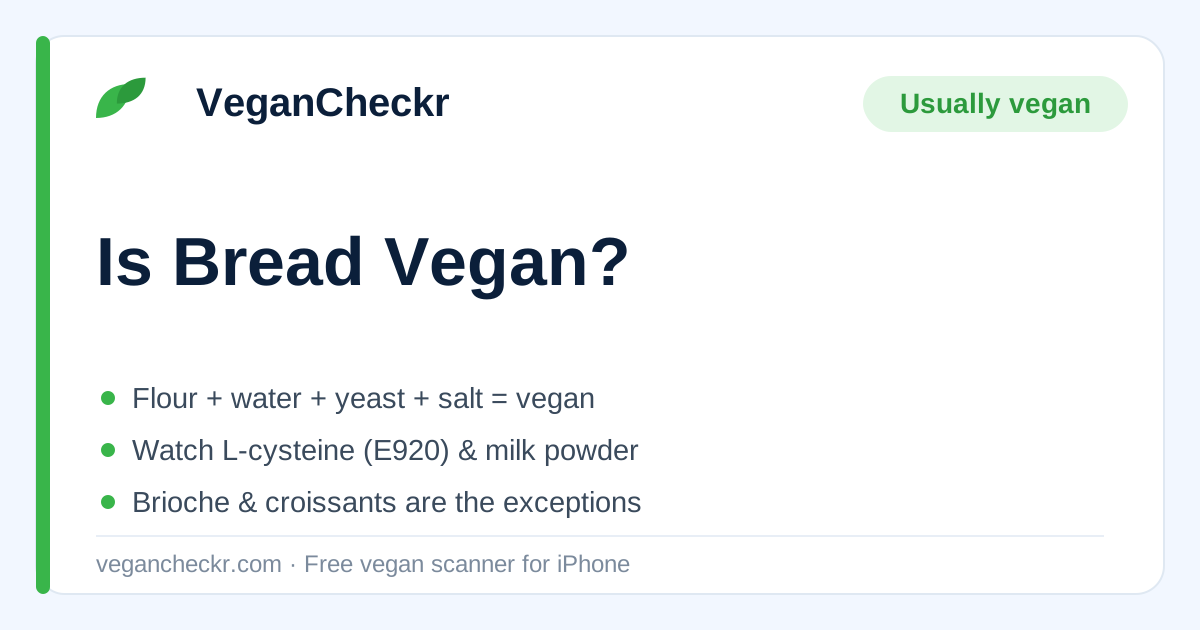
That's the short answer. The longer answer is more interesting, because bread sits at two extremes. A baker making a loaf by hand needs four ingredients, and every one of them comes from a plant or a microbe. An industrial bakery producing a loaf that stays squeezably soft for two weeks needs a longer list. That is where animal ingredients creep in.
This guide covers every non-vegan ingredient that realistically shows up in bread, starting with the one almost nobody talks about.
L-cysteine (E920): a source-dependent dough additive
L-cysteine is an amino acid used as a dough conditioner. It relaxes gluten, which lets industrial bakeries mix dough faster, run it through machinery more easily and get a softer, more uniform crumb. You'll find it in some mass-produced breads, bagels, pizza bases and croissant-style pastries, listed as "L-cysteine", "cysteine hydrochloride" or E920.
The problem is the production route. Commercial L-cysteine can be extracted from keratin-rich material such as poultry feathers or hog bristles, or produced by microbial fermentation using plant-derived glucose. Reliable public data do not establish which route holds the larger current global market share, so a label that says only “L-cysteine” or “E920” does not support an animal or vegan conclusion by itself.
Current EU specifications exclude human hair as a source for food-additive E920. Animal keratin and fermentation routes still produce the same named additive, though, and standard ingredient labels do not identify the manufacturing route. Our complete L-cysteine and E920 guide explains the evidence, regional rules and questions to ask a manufacturer.
The practical rule: treat L-cysteine as non-vegan unless the manufacturer confirms a plant or synthetic origin, or the product carries a certified vegan label. It belongs on the same watch list as the other E-numbers that are not vegan.
 Check it in seconds with VeganCheckr
You don't need to memorize which loaves use E920 or hidden dairy:
- Open VeganCheckr and tap Scan.
- Point your camera at the barcode on the bread bag.
- Read the verdict. Flagged ingredients like L-cysteine (E920), whey or E471 are listed with the reason each one was flagged.
Dairy in disguise: milk powder, whey and butter
Dairy is the most common reason a supermarket loaf fails the vegan test. Soft white and wheat sandwich breads, especially in the US, often include skimmed milk powder, whey, buttermilk or butter to tenderize the crumb and add flavour. As of 2026, several major American brands (Sara Lee, Sunbeam and others) list milk derivatives, butter or honey across most of their range, though recipes change, so the current label always wins.
Watch for these words on bread labels: milk, milk powder, whey, buttermilk, butter, casein, caseinate, lactose. In the EU and UK, milk is one of the 14 allergens that must be emphasized (usually in bold) in the ingredient list, which makes it one of the easier catches. In the US, a "Contains: Milk" line below the ingredients does the same job.
The other ingredients to watch for
Honey
"Honey wheat" loaves, some bagels and many commercial burger buns use honey as the sweetener. Most vegans avoid it because it's an animal product made by bees. If that feels like a technicality, whether honey is vegan makes the longer case. Sugar or malt syrup in the same position is plant-based.
Eggs and enriched doughs
Brioche, challah, most croissants and other "enriched" doughs get their rich, golden texture from eggs and butter, so they are rarely vegan. Egg also appears as a glossy wash brushed on rolls and pretzels before baking, which an ingredient list will reveal but your eyes might not. Naan needs its own recipe check: restaurant and packaged versions may use yogurt, ghee, butter, milk or egg, while clearly labelled vegan recipes exist.
Mono- and diglycerides (E471)
E471 is an emulsifier that keeps industrial bread soft, and it's genuinely ambiguous: it can be made from plant oils or from animal fat, and the label rarely says which. Many manufacturers use plant-derived E471, but you can't tell from the ingredient list alone. How to handle it without guessing is the whole subject of whether E471 is vegan.
Vitamin D3 and other fortification
Some fortified breads add vitamin D3, which is usually derived from lanolin (the grease in sheep's wool). Vitamin D2 is plant-friendly; D3 usually isn't, unless it's specified as lichen-derived. Nothing about the word "fortified" hints at sheep, which is why D3 turns up in hidden animal ingredients in food.
Lard in tortillas
Not a loaf, but worth flagging: traditional flour tortillas are made with lard (pork fat), and some brands still use it. Corn tortillas are just masa, water and lime, so they are almost always vegan.
Bread types compared: what's usually safe and what isn't
| Bread type | Typical verdict | What to watch for |
|---|---|---|
| Sourdough | Almost always vegan | Specialty supermarket loaves with added butter, milk or honey |
| Baguette / French bread | Almost always vegan | Industrial versions may add E471 or L-cysteine |
| Pita, ciabatta, focaccia | Usually vegan | Cheese or honey toppings on focaccia |
| Soft sandwich loaf | Check every time | Milk powder, whey, butter, honey, E471, L-cysteine, vitamin D3 |
| Bagels | Usually vegan, but check | L-cysteine, honey, egg or milk in enriched varieties |
| Flour tortillas & wraps | Often vegan, worth checking | Lard in traditional recipes, mono- and diglycerides |
| Naan | Traditionally not vegan | Yogurt, ghee, butter, milk, sometimes egg |
| Brioche & challah | Rarely vegan | Butter, eggs and milk are the defining ingredients |
| Croissants & laminated pastries | Almost never vegan | Butter throughout; some also use L-cysteine |
Why sourdough and baguettes are the safe bets
Traditional sourdough is flour, water and salt, leavened by a wild culture of yeast and bacteria. There is simply nowhere for an animal ingredient to hide, which makes a proper sourdough loaf one of the most reliably vegan foods you can buy. The only caveat is supermarket "sourdough style" loaves, which sometimes add dairy or use yeast plus flavourings rather than true fermentation.
France went a step further and legislated the matter. Under the 1993 Décret Pain, a baguette de tradition française may contain only wheat flour, water, salt and yeast or leaven; additives are prohibited outright. If you're standing in a French boulangerie, the "tradition" is vegan by law.
If a loaf needs a longer ingredient list than "flour, water, salt, yeast", it needs a second look. Bread only stops being vegan when someone adds softness, sweetness or shelf life.
How to check any bread in ten seconds
For packaged bread, scan the ingredient list for the short watch list: milk (in any form), whey, butter, eggs, honey, L-cysteine/E920, E471, vitamin D3. Allergen labelling does half the work: milk and egg must be declared prominently in the EU, UK and US. The rest is additive-spotting, a technique the field guide to reading food labels as a vegan takes apart properly.
Bakery bread is trickier: no barcode, and often no packaging at all. Ask the baker, or check the printed ingredient card most bakeries and supermarket in-store bakeries display or provide on request.
No barcode? Scan the ingredient list instead
For bakery loaves and in-store bakery labels, use VeganCheckr's ingredient scan:
- Open VeganCheckr and choose ingredient scan.
- Photograph the printed ingredient card or label. No barcode needed.
- The app analyzes the list and flags anything animal-derived or ambiguous, from whey to E920.
- Save the breads that pass, so your next shop takes seconds.
Frequently asked questions
Is sourdough bread vegan?
Almost always. Traditional sourdough contains only flour, water and salt, leavened by a wild yeast starter, so there are no animal ingredients at all. Just check specialty supermarket loaves, which occasionally add butter, milk or honey for flavour.
What is L-cysteine (E920) made from?
Commercial L-cysteine can be extracted from keratin-rich material such as feathers or bristles, or made by microbial fermentation from plant-derived glucose. Human hair is excluded by current EU food-additive specifications. Bread labels rarely state which production route supplied the E920.
Why isn't all supermarket bread vegan?
Industrial bakeries add ingredients that soften the crumb and extend shelf life: milk powder, whey, butter, honey, mono- and diglycerides (E471) and the dough conditioner L-cysteine (E920). None of them are needed to make bread. They are cheap and effective, though, so they are common in soft sandwich loaves.
Are bagels vegan?
Plain bagels are traditionally vegan: flour, water, salt, yeast and malt. But some commercial bagels use L-cysteine as a dough softener, honey as a sweetener, or eggs and milk in enriched varieties, so check the ingredient list before you buy.
Is a French baguette vegan?
Almost always. Under France's 1993 bread decree, a baguette de tradition française may contain only wheat flour, water, salt and yeast. Additives are prohibited. Standard baguettes elsewhere are usually vegan too, though industrial versions can contain E471 or L-cysteine.
Check any product in seconds
VeganCheckr scans barcodes and ingredient labels, flags hidden animal ingredients and E-numbers, and shows you the evidence. Free to download on the App Store and Google Play. Optional Premium features vary by platform.

 Scan with your iPhone camera