≈ Check the exact product Some Pringles formulas list no obvious animal ingredient, while many flavored varieties contain milk, whey, cheese, sour cream, butter or honey. The current US records reviewed here show dairy in several flavors and a source-dependent emulsifier in Original. Check the flavor, pack size and country.
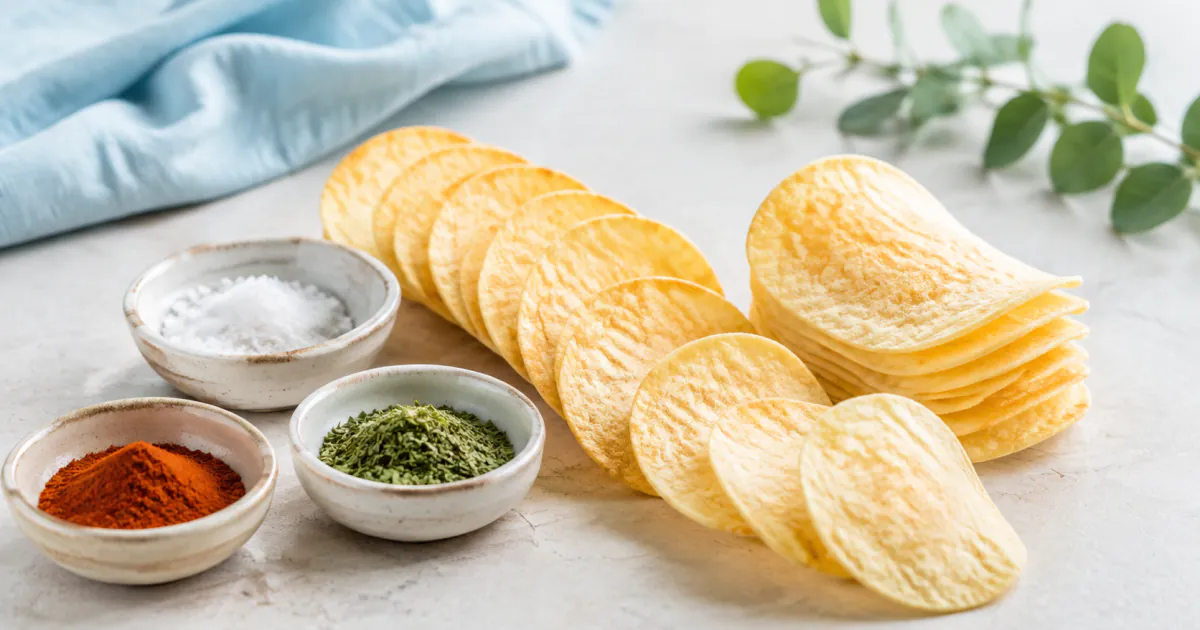
This article was checked against current Pringles and Kellanova US information on September 4, 2026. Formulas can change without the can design changing, and an imported can may not match a domestic one.
The practical Pringles verdict
The answer is not “all Pringles are vegan,” and it is not “all Pringles contain dairy.” The common potato-crisp base can be free of obvious animal ingredients. Flavor powders are where many cans fail, while an emulsifier in the base leaves some apparently plain products unconfirmed for strict shoppers.
| US product checked | What the official information shows | Vegan conclusion |
|---|---|---|
| Original | No milk or egg listed; contains mono- and diglycerides | No obvious animal ingredient, but not officially confirmed vegan |
| Sour Cream & Onion | Whey, nonfat milk, sour cream, buttermilk, cream and cultured milk | Not vegan |
| Cheddar Cheese | Whey, cheddar and blue cheese, butter, buttermilk and nonfat milk | Not vegan |
| Pizza | Whey, cheddar cheese, buttermilk and cream | Not vegan |
| Honey Mustard | Honey and whey; allergen statement declares milk and wheat | Not vegan |
This is a snapshot, not an approved list. Limited editions come and go, and grab-and-go cups can carry a different record from a full-size can. The package in your hand is the deciding source.
Choose by the current ingredient panel, not by a remembered can color or an old list of “accidentally vegan” flavors.
What the official product records can confirm
Kellanova's current SmartLabel records provide product-specific ingredients, allergen statements and selected claims. They let us rule out flavors with dairy or honey and see exactly what is disclosed for Original, but they do not create a brand-wide vegan list or settle the source of every ambiguous ingredient.
This guide therefore reports what each cited record supports instead of treating the range as one product. An ingredient-compatible formula may be acceptable to some vegans, but the absence of milk and egg is not the same as confirmation about every source-dependent ingredient or processing aid.
Are Original Pringles vegan in the US?
US Original Pringles list no obvious animal-derived ingredient, but the official data does not make them a confirmed vegan product. Kellanova's SmartLabel record for US Original, accessed September 4, 2026, lists dried potatoes, vegetable oil, corn flour, cornstarch, rice flour, maltodextrin, mono- and diglycerides, salt and wheat starch. It declares wheat, not milk or egg, and shows a kosher pareve claim.
The unresolved item for strict vegans is mono- and diglycerides. These emulsifiers can be manufactured from plant or animal fats, and the ingredient name does not disclose which source was used. In Europe the same family is commonly declared as E471. Our E471 vegan guide explains what evidence settles the source and why guessing from the rest of a formula is unreliable.
Kosher pareve does not close that gap. Pareve means the food is classified without meat or dairy under kosher rules; it is not a vegan certification and does not apply every vegan standard. A shopper who accepts source-ambiguous emulsifiers may choose US Original. Someone who wants confirmed plant sourcing should ask Kellanova about the exact UPC or choose a product with an explicit vegan mark.
 Scan the can, not the color
Use VeganCheckr's ingredient scan to flag milk, whey, cheese, butter, honey and source-dependent emulsifiers on the exact can. Confirm ambiguous flags with the manufacturer when you need a strict verdict.
Get VeganCheckr for iPhone or AndroidWhich Pringles flavors clearly are not vegan?
Flavors built around cheese, sour cream or creamy dairy seasonings are the easiest exclusions. The current US Sour Cream & Onion SmartLabel lists whey, nonfat milk, sour cream, buttermilk, cream and cultured nonfat milk. The allergen statement says it contains milk and wheat. That is a clear non-vegan verdict, not a cross-contact caveat.
The official Cheddar Cheese SmartLabel lists whey, cheddar and blue cheese, butter, buttermilk and nonfat milk. The Pizza SmartLabel lists whey, cheddar cheese, buttermilk and cream. A flavor can contain several dairy ingredients even when each appears below the “contains 2% or less” divider. A small percentage does not change its vegan status.
Honey-flavored varieties also need care. The current US Honey Mustard SmartLabel explicitly lists honey and whey and declares milk, so that product is not vegan. Honey is an animal-produced ingredient under the standard definition used by this site; our honey guide explains the reasoning.
The ingredients most likely to change the answer
On a Pringles label, look for these groups:
- Direct dairy: milk, whey, lactose, casein or sodium caseinate, buttermilk, cream, sour cream, butter and cheese.
- Animal-produced sweeteners: honey.
- Source-dependent ingredients: mono- and diglycerides or E471, and flavorings whose source the label does not identify.
- Cross-contact language: “may contain milk” describes possible unintended traces and is not the same as milk in the ingredient list.
Lactic acid often appears beside dairy ingredients, but its name does not mean it came from milk. It is commonly made by microbial fermentation and requires product-specific evidence only when a manufacturer does not disclose the source. Our lactic acid guide separates the chemical from lactose and milk protein.
MSG is also not an animal ingredient by default. The presence of monosodium glutamate in a savory flavor does not prove meat or dairy. Read the complete seasoning for explicit animal ingredients and investigate ambiguous flavors; our MSG guide covers the manufacturing question.
Why country and pack format matter
Pringles publishes different regional product pages because formulas vary. An official Eastern Europe Original page lists dehydrated potatoes, sunflower oil, corn flour, wheat flour, rice flour, maltodextrin, E471, rapeseed oil, salt and annatto norbixin. It also gives a precautionary “may contain milk, soy” notice and tells shoppers that recipes are adjusted from time to time.
That formula is similar to the US Original but not identical. The flour wording, oils, color and allergen notice differ. A claim attached to a UK, German, Australian or US can should stay attached to that market. Imported cans, travel-size packs, variety packs and promotional flavors should be checked as separate products.
A “may contain milk” statement is not an intentional milk ingredient. Many vegans accept products carrying shared-facility warnings, while people with milk allergies must follow medical and manufacturer guidance. Our broader label-reading guide shows where the allergen statement ends and the ingredient audit begins.
A 45-second check in the snack aisle
- Match the country and exact flavor. Do not use an online verdict that reviews a different market.
- Read the Contains statement. Milk or egg there makes the answer immediate, but their absence is only a shortcut.
- Read every seasoning ingredient. Look for whey, cheese, butter, cream, buttermilk, lactose, casein and honey.
- Investigate source-dependent terms. E471 and vague natural flavors may require an explicit vegan label or manufacturer reply.
- Check the package date and UPC. A recent reformulation may be on shelf beside older stock.
If the answer remains unclear, send the manufacturer a photo of the ingredient panel, UPC, best-before code and country of purchase. Ask whether the specific product contains any animal-derived ingredients or processing aids and whether its mono- and diglycerides are wholly plant-derived. That question is more likely to get a useful answer than asking whether “Pringles” as a global brand is vegan.
The bottom line
There is no trustworthy blanket verdict for Pringles. The US flavored cans checked here contain dairy, honey or both. US Original currently lists no obvious animal ingredient, but it includes source-dependent mono- and diglycerides, and the cited record does not confirm it as vegan.
Use the exact label, country and UPC. If you are comfortable with an unresolved emulsifier, you may reach a different personal decision on Original than a shopper who requires explicit plant sourcing. Both should avoid turning that decision into a global list of approved flavors.
Frequently asked questions
Are Original Pringles vegan in the US?
The current US ingredient list contains no obvious animal ingredient, but it includes mono- and diglycerides whose source is not stated. The cited record does not display a vegan certification or resolve that source, so strict shoppers should treat it as unconfirmed.
Do Pringles contain milk?
Many flavored Pringles do. Current US Sour Cream & Onion, Cheddar Cheese, Pizza and Honey Mustard records list milk ingredients. Original declares wheat but no milk as an intentional ingredient. Always check the exact can.
Is a “may contain milk” Pringles can vegan?
The wording normally describes possible cross-contact, not milk deliberately added to the recipe. Many ethical vegans accept that distinction, but anyone with a milk allergy should follow the package warning and medical guidance.
Are Pringles vegan in every country?
No single answer covers every country. Regional formulas and labels differ, and Pringles advises customers to review the package because recipes can change.
Does kosher pareve mean vegan?
No. Pareve indicates a product is classified without meat or dairy under kosher rules. It is not a vegan certification and does not necessarily resolve every ingredient source or processing aid.
Check any product in seconds
VeganCheckr scans barcodes and ingredient labels, flags hidden animal ingredients and E-numbers, and shows you the evidence. Free to download on the App Store and Google Play. Optional Premium features vary by platform.

 Scan with your iPhone camera