Usually still vegan A product can still be vegan when its label says “may contain milk.” This is a precautionary allergen warning about possible unintended cross-contact, not a statement that milk was deliberately used. It is not evidence that the food is safe for someone with a milk allergy.
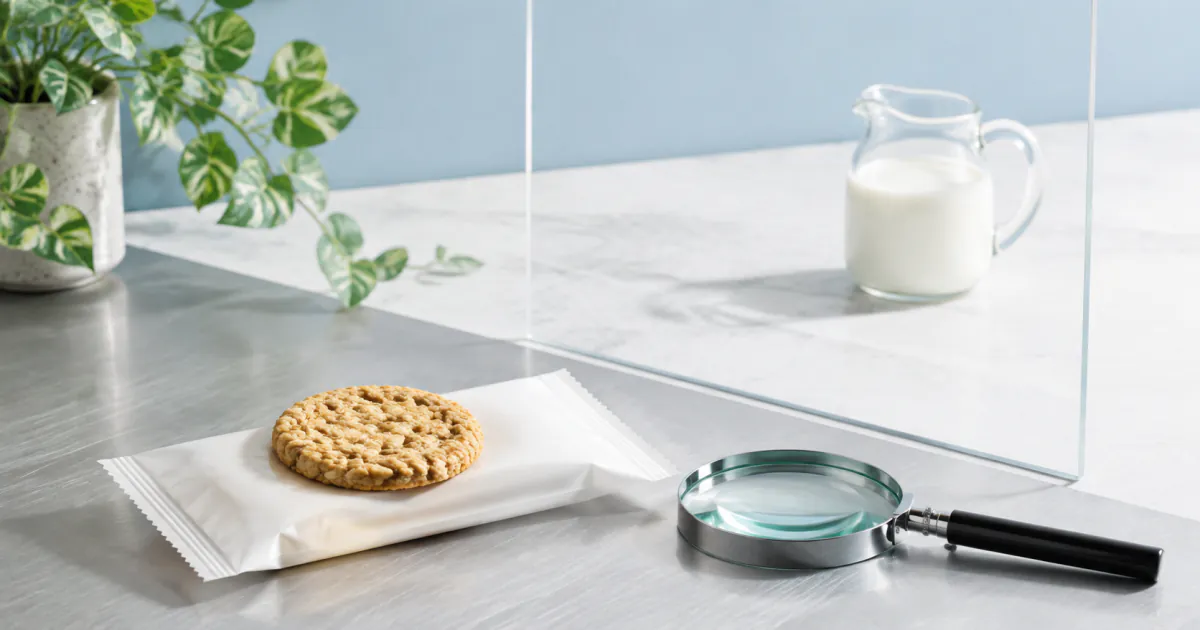
“Contains milk” and “may contain milk” are different
The fastest way to read the pack is to separate intentional ingredients from precautionary information. If the ingredients name milk, whey, casein, butter, cream, lactose or cheese, the recipe contains dairy and is not vegan. A separate “contains milk” allergen statement confirms that an ingredient is from milk. By contrast, “may contain milk” warns that unintended traces are possible because of manufacturing conditions.
The US Food and Drug Administration calls these phrases voluntary allergen advisory statements. Its food allergen overview explains that “may contain” and “produced in a facility with” are used to alert people to possible allergen cross-contact. Cross-contact can happen when products share equipment, production lines, dust in a facility or other handling steps.
| Label wording | What it normally means | Vegan reading | Allergy reading |
|---|---|---|---|
| Contains milk | A listed ingredient comes from milk | Not vegan | Contains a milk allergen |
| Milk / whey / casein in ingredients | Dairy was intentionally used in the recipe | Not vegan | Contains a milk allergen |
| May contain milk | Unintended milk cross-contact is possible | Can still be vegan if the recipe and process meet a vegan standard | Do not treat as milk-free |
| Made in a facility that handles milk | Shared-site cross-contact is possible | Can still be vegan | Take the warning seriously; wording does not rank the risk |
| Vegan | No animal ingredient was intentionally used under that standard | Useful vegan claim | Not an allergen-free claim |
A vegan claim answers an ingredients-and-production question. A “may contain milk” statement answers an allergy-risk question. Neither can replace the other.
“May contain milk” vs “not suitable for milk allergy sufferers”
Both can be precautionary warnings about unintended milk cross-contact. “Not suitable for milk allergy sufferers” does not necessarily mean milk was deliberately added, and “may contain milk” does not mean the product is the safer of the two. Read the complete ingredient list as well as the warning.
The UK government's precautionary allergen guidance includes both “may contain” and “not suitable for” wording for cross-contact risks that cannot be removed. The phrase alone is not a measurement of the amount of milk present.
For a vegan sourcing decision, distinguish deliberate dairy ingredients from possible accidental traces. For a milk allergy, do not choose between these products by assuming one phrase means lower risk: follow your clinician's plan and the manufacturer's current allergen information. Neither warning is a milk-free guarantee.
Why a vegan product can carry the warning
Vegan standards focus on avoiding deliberate animal use. They do not all require a dedicated factory in which milk, eggs and every other animal-derived allergen are absent. A bakery may make a plant-based biscuit after a milk-chocolate biscuit on the same line. Cleaning and scheduling can reduce transfer, but the business may still identify a residual cross-contact risk.
The Vegan Society’s allergen-labelling explanation is explicit: products registered with its Vegan Trademark can carry “may contain” statements when cross-contamination is minimised and effectively managed. The organisation also says its vegan checks are not an allergen standard. That is why a vegan logo and a milk warning can appear on the same pack without contradicting each other.
Some vegans personally avoid any shared-equipment warning. That is a valid individual choice, but it is stricter than the usual distinction between an intentional ingredient and an accidental trace risk. If you follow that stricter rule, look for brands with dedicated dairy-free facilities rather than assuming every product called vegan meets it.
Why allergy safety needs a stricter answer
Milk allergy can involve reactions to very small amounts of milk protein. A precautionary statement does not promise that traces are present in every pack, but it also does not promise they are absent. The FDA notes that the wording of advisory statements does not reliably indicate the likelihood or level of an allergen. “Made in a facility” is not automatically a lower-risk version of “may contain.”
Current UK government allergen-labelling guidance gives the same practical warning from the other direction: vegan labelling does not guarantee a food is free from an allergen, and “may contain milk” is precautionary wording for possible accidental traces. A vegan claim is not a promise that the product is safe for a person with a milk allergy.
If you or someone you are feeding has a diagnosed milk allergy, follow their clinician’s plan and the exact allergen information on the current pack. Do not use this page, an app verdict or a vegan logo to overrule a “may contain milk” warning. Recipes and factory arrangements can change even when the front of the pack looks familiar.
A four-step way to judge the label
- Read the complete ingredient list first. Look for deliberate dairy ingredients, including milk powder, whey, casein, caseinate, butterfat, cream, cheese, lactose and milk-derived chocolate.
- Check the allergen statement. “Contains milk” confirms an ingredient source. “May contain milk” or shared-facility wording reports a possible unintended presence.
- Look for a credible vegan claim. Certification is useful when broad terms such as flavours or processing aids leave the recipe unclear. It still does not certify allergy safety.
- Apply the right personal threshold. For vegan sourcing, a managed trace warning is usually compatible. For milk allergy, use the medical safety plan and contact the manufacturer if the label does not answer your question.
This order prevents one bold allergen word from hiding what the label actually says. Our step-by-step vegan label guide covers the same method across milk, egg, fish and source-dependent additives. If the uncertain item is an unfamiliar compound rather than an allergen statement, use the vegan ingredient checker guide to decide when a manufacturer question is worthwhile.
 Separate ingredients from trace warnings
VeganCheckr can scan a barcode or ingredient label and help you review the complete recipe:
- Check whether milk, whey, casein or another animal-derived ingredient was deliberately added.
- Review uncertain additives with their evidence instead of treating every bold allergen word as an ingredient.
- Keep following the pack’s precautionary warning separately if allergy safety matters.
Examples that commonly cause confusion
Dark chocolate
A dark bar may have cocoa mass, cocoa butter and sugar as its complete recipe, followed by “may contain milk.” By ingredients, that can be vegan; by allergy risk, it is not milk-free. Another dark bar may list milk fat or skimmed milk powder, making it non-vegan regardless of any precautionary wording. Our dark chocolate guide shows why cocoa percentage alone does not settle the issue.
Crisps and savoury snacks
A plain or chilli-flavoured snack can have a plant-based recipe but share equipment with a cheese flavour. The cross-contact warning does not turn the first recipe into cheese. However, whey powder, cheese powder or milk-derived flavouring in the ingredients would make that flavour non-vegan. Compare flavours individually because one brand name does not guarantee one formula.
Biscuits and bakery products
Flour, vegetable oil, sugar and raising agents can form a vegan biscuit, while the same plant also handles butter biscuits. Here again, “may contain milk” points to the factory risk. Butter, whey, milk chocolate or an egg wash in the recipe is an intentional animal ingredient. The hidden animal ingredients guide helps decode less obvious dairy names.
Products labelled plant-based
“Plant-based” has no single global meaning and may be used more loosely than a vegan certification. Read the ingredients and production claim rather than relying on the phrase alone. A precautionary milk warning is not the problem, but an actual milk ingredient is. If the company describes the product as vegetarian rather than vegan, that may signal deliberate dairy or egg.
What manufacturers should do with “may contain”
Precautionary allergen labelling is not meant to excuse poor controls. The FDA says advisory statements should not replace current good manufacturing practices. The Food Standards Agency's business guidance likewise requires effective allergen management and describes segregation and cleaning as controls for cross-contact; precautionary information is for risk that cannot be avoided.
This matters because indiscriminate warnings reduce their usefulness. A careful label tells shoppers which allergen is at issue, while a vague blanket warning can unnecessarily restrict food choices. Consumers cannot audit a factory from the aisle, so the manufacturer remains responsible for accurate ingredients, suitable controls and truthful precautionary information.
Frequently asked questions
Can vegans eat food that says “may contain milk”?
Usually, yes. The warning describes possible accidental cross-contact rather than milk deliberately added to the recipe. Many vegan standards allow it when reasonable controls minimise the risk. Check the actual ingredients and any credible vegan certification, then apply your own approach to shared equipment.
Does “made in a factory that handles milk” mean the product contains dairy?
No. It means dairy is handled at the facility and unintended transfer may be possible. The FDA cautions that different advisory phrases do not provide a dependable ranking of risk, so people with a milk allergy should not assume this wording is safer than “may contain milk.”
Does “not suitable for milk allergy sufferers” mean it is not vegan?
Not by itself. It may describe a cross-contact risk rather than a milk ingredient. Check the full recipe and vegan claim separately, and never interpret vegan suitability as permission to ignore an allergy warning.
Is a vegan label safe for a milk allergy?
Not automatically. Vegan labelling addresses intentional animal-derived ingredients and practices, while allergy labelling addresses possible exposure to allergenic protein. Always check the precautionary allergen statement and follow the allergy plan given by a qualified clinician.
What if the ingredients list milk but the front says vegan?
Treat the current ingredient and allergen information as decisive and do not eat it as vegan. Packaging errors, formula changes or a mismatched front label are possible. Contact the manufacturer with the product name, market, flavour and batch details so it can investigate.
Check any product in seconds
VeganCheckr scans barcodes and ingredient labels, flags hidden animal ingredients and E-numbers, and shows you the evidence. Free to download on the App Store and Google Play. Optional Premium features vary by platform.

 Scan with your iPhone camera