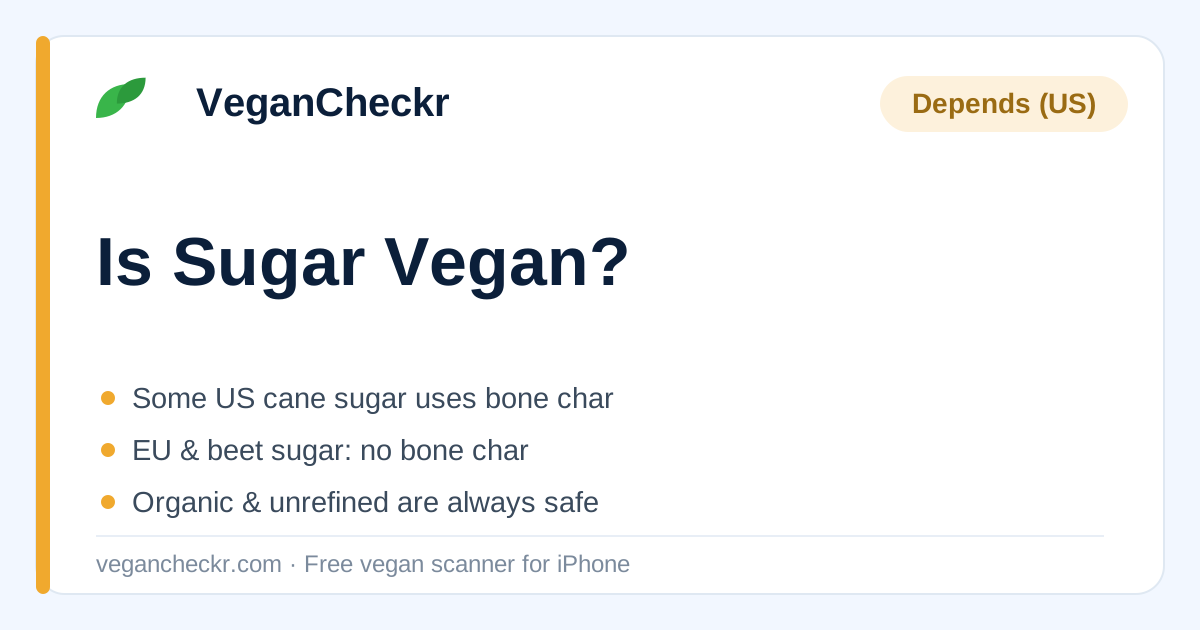
≈ Usually vegan Sugar contains no animal ingredients. The catch: some US cane sugar refineries whiten it by filtering it through bone char, made from cattle bones. Beet sugar, certified-organic sugar and unrefined sugars never involve bone char. Most European sugar comes from beets, so this is largely a US question.
That short answer hides one of the longest-running debates in vegan eating. Sugar sits in almost every packaged food, so if bone-char-filtered sugar were truly off-limits, half the supermarket would be too. Let's unpack what bone char actually is, which sugars can involve it, how to find transparent brands, and what the major vegan organizations say about how strict you actually need to be.
What is bone char, and why do sugar refiners use it?
Bone char is made by charring cattle bones at high temperatures until they become a porous, carbon-rich material made mostly of tricalcium phosphate. Some cane sugar refineries pack it into giant filter columns and pass liquid sugar through it to strip out the brown plant pigments, leaving the bright white crystals shoppers expect.
The scale is what surprises most people. According to the Vegetarian Resource Group's refinery survey, one cow yields about nine pounds of bone char, and filling a single commercial filter column takes bones from nearly 7,800 cattle. The bones are typically bought from overseas traders as a slaughterhouse by-product.
Two things follow from that. First, no bone material ends up in the sugar: bone char is a filter the syrup passes through, not an additive, so the finished product is essentially pure sucrose. Second, bone char isn't the only way to do the job: activated carbon and ion-exchange systems decolorize sugar just as well, and plenty of refiners use them. The objection is about the process, not the contents of the bag.
Which sugars are vegan, and which can involve bone char
If you just want a list of vegan sugar to shop from, this is it. The sugar type on the label usually settles the question by itself:
| Sugar type | Bone char? | Why |
|---|---|---|
| US refined white cane sugar | Possible | Some large US refiners still decolorize with bone char; others use activated carbon or ion exchange |
| US brown sugar | Possible | Usually refined white sugar with molasses added back, so it inherits the refinery's process |
| US powdered (confectioner's) sugar | Possible | Ground refined white sugar plus starch; same story as above |
| Beet sugar | Never | Beet sugar processing never uses bone char filtration |
| USDA certified organic cane sugar | Never | Organic certification rules out bone-char filtering |
| Turbinado, demerara, muscovado | No | Minimally refined raw-style sugars aren't filtered through bone char |
| Coconut sugar | Never | Not processed with bone char |
| Sugar produced in the EU and UK | Rarely an issue | Mostly beet-based; the EU is the world's leading beet sugar producer |
Notice the pattern: the whiter and more refined the cane sugar, the more likely bone char was involved. Anything unrefined, organic or beet-derived is in the clear by definition.
So the short shopping list of vegan sugar is beet sugar, certified organic cane sugar, coconut sugar, and the raw-style sugars (turbinado, demerara, muscovado). Every one of those is vegan wherever you buy it, with no brand research required. Plain white cane sugar bought in the United States is the only common case that needs a second look.
The US picture: why "sugar" on a label is a question mark
In the United States, a handful of very large companies refine most of the cane sugar. In the Vegetarian Resource Group's survey, the refiners behind household names like Domino and C&H reported using bone char at most of their facilities, while at least one plant ran an ion-exchange system instead. That means the same brand can produce both bone-char-filtered and bone-char-free sugar, with no way to tell from the bag.
It gets murkier one step downstream. Food manufacturers buy commodity sugar from multiple suppliers, so when a cookie or cereal lists "sugar", nobody (often not even the manufacturer) can say which refinery it came from. That's exactly the ambiguity behind debates like Are Oreos Vegan?, where the recipe itself is free of animal ingredients but the sugar's history is unknowable.
The good news is that brand transparency has improved. PETA maintains a list of companies that don't use bone-char filters, including Trader Joe's, Bob's Red Mill, Wholesome, Florida Crystals, Redpath, Kroger's Simple Truth and Target's Good & Gather lines. Company practices can change, so for anything not on a current list, a quick email to the producer usually gets a straight answer.
 Check it in seconds with VeganCheckr
Sugar is one line on a label, and the scanner reads the whole thing:
- Open VeganCheckr and tap Scan, then point your camera at any product's barcode.
- Read the verdict with evidence. Every flagged ingredient and additive is listed by name, so you can see whether sugar is the only question mark or there's gelatin or carmine hiding further down.
- Found a bone-char-free sugar brand you trust? Add it to your saved products so it's one tap away on the next shop.
Europe and the UK: mostly a beet story
If you shop in Europe, you can mostly stop worrying. The EU is the world's leading producer of beet sugar, accounting for around half of global beet sugar output per the European Commission, and beet sugar is never filtered through bone char. The plain "sugar" in most European products is beet-derived, refined with processes that never needed bone char in the first place.
Imported cane sugar does exist on European shelves, so the question isn't strictly impossible there, but it's the exception rather than the rule. It's one of the few label questions where geography does most of the work for you.
How strict should you be? The pragmatic answer
Here's where it's worth stepping back. The Vegan Society defines veganism as a way of living that "seeks to exclude — as far as is possible and practicable — all forms of exploitation of, and cruelty to, animals". That "possible and practicable" clause exists precisely for cases like this: commodity sugar is anonymous by the time it reaches a product, and auditing every ingredient's processing history is not a practicable standard for anyone.
Even PETA, not an organization famous for leniency, tells vegans not to stress over sugar processing, arguing that the impact of being vegan matters far more than chasing perfection. Bone char is a by-product of a slaughter industry driven by meat demand; refusing a cookie with ambiguous sugar doesn't reduce that demand the way skipping the burger does.
In practice, most vegans land in one of three camps. Some ignore the issue entirely, since no animal ingredient is in the sugar. Some buy bone-char-free sugar for home baking (an easy, zero-sacrifice switch) and don't interrogate packaged foods. And some avoid ambiguous US cane sugar altogether, which is a coherent choice too, just a demanding one. All three are recognizably vegan; the difference is where you draw the process line, the same judgment call raised by wine fining agents.
Bone char is an argument about how sugar is made, not what's in it, which is why even the strictest vegan organizations treat it as a place for pragmatism, not purity tests.
Wherever you land, it's worth keeping perspective: sugar is a processing question, while gelatin, carmine and milk derivatives are actual animal ingredients that appear in thousands of products. The ones that matter on every label, not just the philosophical edge cases, are collected under hidden animal ingredients.
How to check the bag in your hand
For sugar you're buying directly, the label usually answers the question in seconds. Look for any of these, all of which rule bone char out: "beet sugar" in the ingredient line, a USDA organic seal, an unrefined style like turbinado, demerara, muscovado or coconut sugar, or a vegan certification mark. If the bag just says "pure cane sugar" with none of the above and it was refined in the US, its history is unknown. That's when brand lists or a direct question to the producer settle it.
For packaged foods, treat "sugar" as low-priority and scan for the genuinely non-vegan stuff first. Work through the order of checks in reading food labels as a vegan and you'll catch the real animal ingredients fast.
No barcode? Scan the label instead
Bakery items and imported sugars often have no barcode in the database, but the camera still has you covered:
- Open VeganCheckr and choose ingredient scan.
- Photograph the printed ingredient list. The app reads it and analyzes every item.
- Get an instant verdict on the whole list, with animal-derived and ambiguous ingredients flagged so sugar isn't the only thing you're judging by eye.
Frequently asked questions
What sugar is vegan?
Beet sugar, certified organic cane sugar, coconut sugar and the raw-style sugars (turbinado, demerara, muscovado) are vegan wherever you buy them. Refined white cane sugar is the only common question mark, and only in the United States, where some refiners still filter it through bone char.
Does bone char end up in the sugar I eat?
No. Bone char is a filter that the liquid sugar passes through, not an ingredient, so the finished product is essentially pure sucrose. The vegan objection is about an animal product being used in the process, not about what is in the bag.
Is brown sugar vegan?
Brown sugar is usually refined white sugar with molasses added back, so it inherits whatever process the refinery used. In the US that can mean bone char. Brown sugar made from beet sugar, certified-organic cane sugar or a confirmed bone-char-free refiner avoids the issue entirely.
Is powdered (confectioner's) sugar vegan?
Same logic as brown sugar: it's finely ground refined white sugar with a little starch, so it depends on how the white sugar was refined. Organic powdered sugar, or powdered sugar from a beet or bone-char-free producer, sidesteps the question.
How do I find out if a specific brand uses bone char?
Look for "beet sugar", a USDA organic seal or an unrefined style (turbinado, demerara, muscovado, coconut) on the label. All of these rule bone char out. A vegan certification mark does the same. Otherwise ask the brand directly; PETA also maintains a list of companies that don't use bone-char filters.
Do I have to avoid regular sugar to call myself vegan?
No. The Vegan Society defines veganism as avoiding animal use "as far as is possible and practicable", and tracing anonymous commodity sugar through every packaged food isn't practicable. Many vegans buy bone-char-free sugar for home use and don't agonize over the rest, which is a coherent, widely accepted position.
Check any product in seconds
VeganCheckr scans barcodes and ingredient labels, flags hidden animal ingredients and E-numbers, and shows you the evidence. Free to download on the App Store and Google Play. Optional Premium features vary by platform.

 Scan with your iPhone camera